
 English
  Spanish
  French
  German
  Portuguese
  Dutch
Dutch  Italian
  Thai
Thai LED grow-light electricity cost is easy to estimate once you separate four inputs: the fixture’s actual input power, its daily runtime, the number of fixtures, and the electricity rate on your bill. The calculation takes less than a minute, yet it can prevent a costly mistake when planning a grow tent, greenhouse supplement, or commercial indoor farm.
This guide shows the formulas, works through single-light and facility examples, explains how dimming and time-of-use rates change the result, and highlights costs that a basic wattage calculation can miss.
The quick formula for monthly grow-light electricity cost
Electric utilities bill energy in kilowatt-hours (kWh). One kilowatt is 1,000 watts, and one kWh is one kilowatt used for one hour. The basic calculation is:
Monthly electricity cost = monthly kWh × electricity rate per kWh
Use the actual number of days in the billing period when reviewing a bill. Thirty days is convenient for planning, but a 28-, 31-, or 35-day cycle changes the total. The U.S. Energy Information Administration’s electricity measurement guide confirms that watts describe power at a moment, while watt-hours and kWh describe energy used over time.
Worked example: one 600W LED grow light
Assume a fixture draws 600W at full output, runs 18 hours per day, and electricity costs $0.15 per kWh.
- Convert watts to kilowatts: 600 ÷ 1,000 = 0.6 kW.
- Calculate daily energy: 0.6 kW × 18 hours = 10.8 kWh/day.
- Calculate 30-day energy: 10.8 × 30 = 324 kWh/month.
- Calculate cost: 324 × $0.15 = $48.60/month.
At the same rate, running that fixture for 12 hours instead of 18 would use 216 kWh and cost $32.40 over 30 days. Runtime matters just as much as wattage.
Monthly energy-use reference table
The table below uses 30 days and an example rate of $0.15/kWh. Replace that rate with your own bill’s figure before budgeting.
| Actual draw | 12 h/day | 16 h/day | 18 h/day |
|---|---|---|---|
| 100W | 36 kWh / $5.40 | 48 kWh / $7.20 | 54 kWh / $8.10 |
| 300W | 108 kWh / $16.20 | 144 kWh / $21.60 | 162 kWh / $24.30 |
| 600W | 216 kWh / $32.40 | 288 kWh / $43.20 | 324 kWh / $48.60 |
| 1,000W | 360 kWh / $54.00 | 480 kWh / $72.00 | 540 kWh / $81.00 |
For a general explanation of why lighting raises a bill and which variables matter, see Does Using Grow Lights Raise Your Electricity Costs? The calculation here goes further by turning those variables into a working budget.
Use actual input watts—not the product name
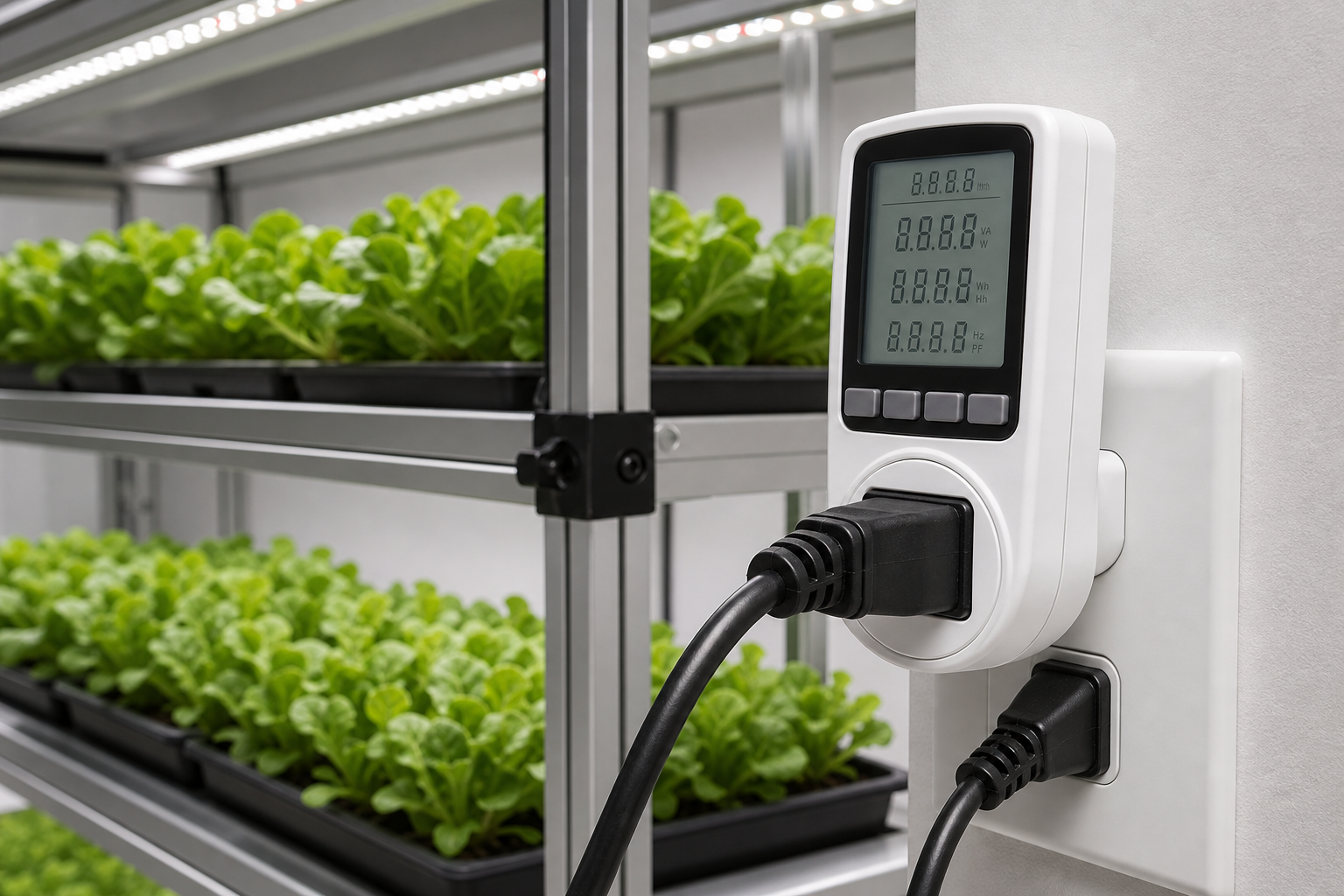
A model name such as “1000” does not always mean the fixture draws 1,000W. Use the rated input power on the specification sheet or electrical label, not an equivalent-output claim. For the most accurate operating figure, measure wall power with a suitable energy meter at the voltage and dimming level you actually use.
Commercial installations should be measured by a qualified person using equipment appropriate for the circuit. Do not open panels or clamp conductors unless you are trained and authorized to do so. A plug-in meter is convenient for compatible single-phase plug loads; building-level monitoring is better for hardwired rooms.
Also allow for driver and manufacturing tolerances. A nominal 150W fixture may not draw exactly 150W in every operating condition. That small difference becomes meaningful across dozens or hundreds of fixtures.
How dimming changes the calculation
If a 600W fixture actually measures 360W at the chosen dim setting, enter 360W in the formula—not 600W. At 18 hours per day and $0.15/kWh, that measured load would use 194.4 kWh and cost $29.16 over 30 days.
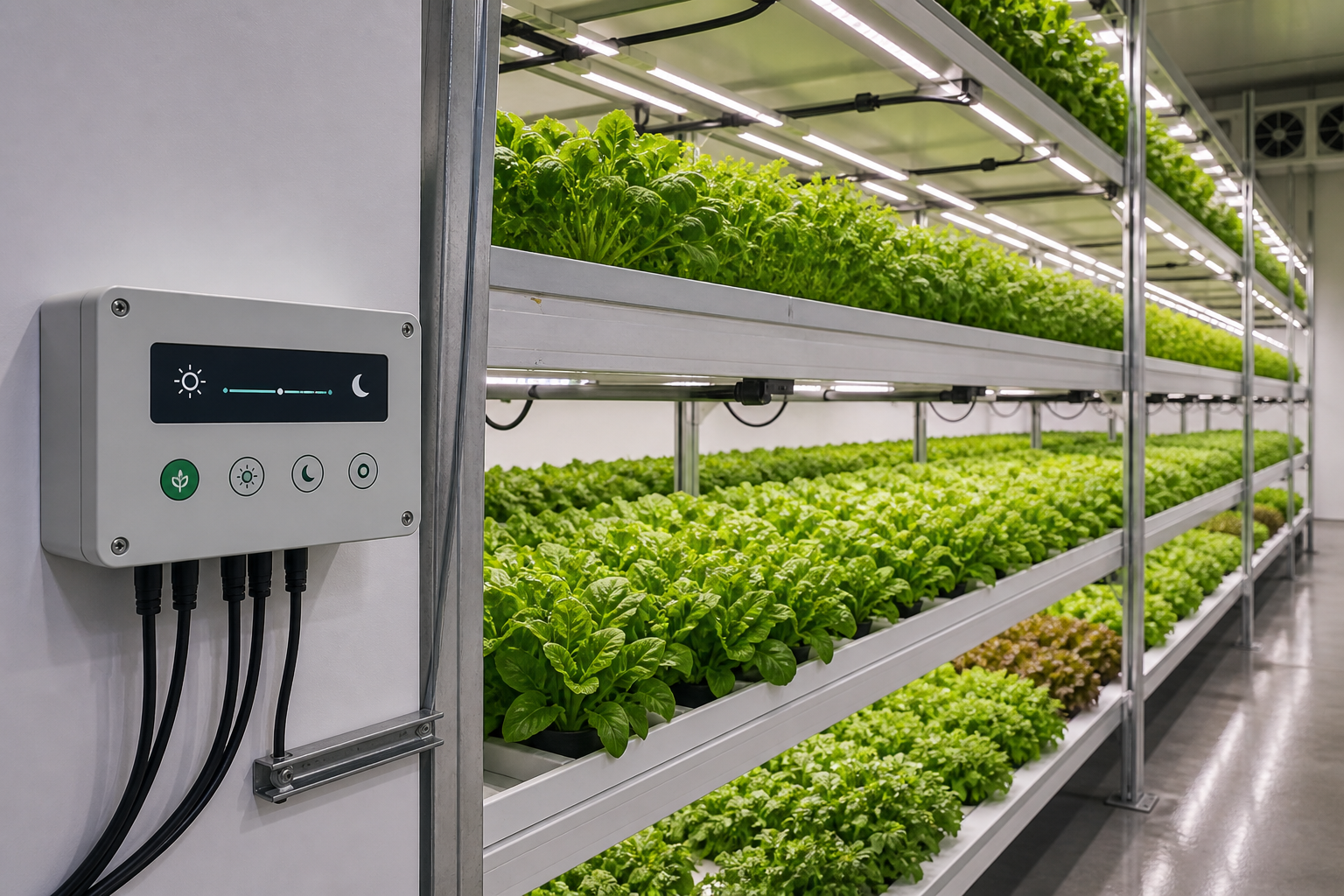
Do not assume a 60% dial position always equals exactly 60% wall power. Driver behavior, controller calibration, minimum output, and fixture design can make the relationship slightly different. Measure representative fixtures at the settings used in production. Kingrowlight’s guide to dimmable LED grow lights explains how output control can also match changing crop needs.
Calculating a room with multiple fixtures
For 20 fixtures drawing 150W each, the connected lighting load is:
150W × 20 = 3,000W, or 3kW
Running that room for 16 hours per day uses 48 kWh daily. Over 30 days, it uses 1,440 kWh. At $0.12/kWh, the energy charge is $172.80.
For rooms with mixed fixtures or dim settings, calculate each group separately and add the totals. A spreadsheet with columns for quantity, measured watts, hours, days, and rate makes scenario comparisons much easier.
Compare delivered light as well as electrical load
Two fixtures can draw similar watts yet deliver different usable photon output and canopy uniformity. Review input watts together with PPF, photon efficacy, PPFD maps, coverage, and dimming control before comparing operating cost.
The difference between PPF, PPFD, and DLI matters because the cheapest light to run is not economical if it cannot deliver the crop’s required daily light. Use the PPF, PPFD, and DLI guide to connect the energy budget to canopy performance.
Find the correct electricity rate
The headline rate on a utility website may not match the effective rate on your bill. For a quick household estimate, divide the bill’s usage-related charges by billed kWh. Keep fixed monthly fees separate if they would exist without the grow lights.
Commercial tariffs can be more complicated:
- Time-of-use pricing: electricity may cost more during peak hours and less overnight.
- Demand charges: part of the bill may depend on the highest average kW demand during a defined interval, not just total kWh.
- Tiered rates: the marginal price may rise after consumption crosses a threshold.
- Taxes and adjustments: fuel, delivery, and regulatory charges may change the all-in cost.
When rates vary by time, split the lighting schedule into rate periods. Multiply the kWh used in each period by that period’s price, then add the results. Before moving lights to an off-peak window, confirm that the new schedule still supports the crop’s photoperiod and environmental plan.
Costs the simple lighting formula does not include
The formula estimates fixture energy only. A complete grow-room budget may also need circulation fans, exhaust or air conditioning, dehumidification, pumps, nutrient dosing, CO₂ equipment, controls, and water treatment. Lighting also becomes heat, so a change in fixture power can affect cooling or heating demand.
Calculate these devices separately using their measured average power and duty cycle. A 500W dehumidifier does not necessarily run continuously; if monitoring shows a 40% duty cycle, its average contribution is closer to 200W during that period. For variable-speed HVAC and pumps, submetering produces a better estimate than nameplate power.
How to compare the operating cost of two grow lights
Do not compare two fixtures at equal runtime unless they provide the same useful light to the same canopy. A fair comparison follows this sequence:
- Define the target average PPFD, coverage area, uniformity, and photoperiod.
- Confirm how many fixtures each option needs to meet that target.
- Use actual input watts at the required output setting.
- Calculate monthly kWh and cost for the complete layout.
- Add expected cooling impact and control requirements.
- Compare cost per production area—or, better, per kilogram of marketable crop.
Photon efficacy, stated in µmol/J, helps compare how much photosynthetic photon output a fixture produces per unit of input energy. It is valuable, but it does not replace a PPFD map: poor distribution can waste useful photons outside the canopy or create hotspots that force operators to dim the whole room.
Practical ways to reduce grow-light energy use
- Match PPFD and DLI to the crop and growth stage instead of running maximum output throughout the cycle.
- Use reliable timers and verify that schedules are not overlapping or extending accidentally.
- Dim or zone fixtures above young, empty, or partially occupied areas.
- Maintain the recommended canopy distance and clean optical surfaces so available light reaches the crop.
- Improve layout and uniformity before adding more wattage.
- When the tariff allows it, shift suitable lighting hours away from expensive peak periods.
- Track kWh per production area and per marketable yield, not only the total bill.
Frequently asked questions
How much does a grow light cost to run per month?
Divide actual watts by 1,000, then multiply by daily hours, billing days, and your price per kWh. A 600W fixture running 18 hours daily for 30 days uses 324 kWh; at $0.15/kWh, it costs $48.60.
Does dimming a grow light reduce electricity use?
Yes. Lower output normally reduces input power, but the percentage on a control knob may not exactly equal the percentage reduction in watts. Measure actual draw at the operating setting.
Should I use volts and amps to calculate cost?
For planning, use rated or measured real input watts. Simply multiplying volts by amps can overstate real power on AC equipment when power factor is below 1. A reliable watt measurement or manufacturer input-power data is preferable.
Are commercial demand charges included?
No. The basic formula covers kWh energy charges. Commercial users should review demand, time-of-use, tiered, delivery, and other tariff components with their utility or energy adviser.
Turn wattage into an operating budget
The essential calculation is simple: actual kilowatts multiplied by operating hours gives kWh, and kWh multiplied by the applicable rate gives energy cost. Accuracy comes from using measured input power, the real timer schedule, the correct billing period, and the right tariff.
For a commercial layout, calculate the full room rather than one fixture and compare energy against delivered PPFD, DLI, uniformity, and marketable output. If you need help matching a lighting layout to crop targets and facility dimensions, contact Kingrowlight with the crop, canopy area, mounting height, photoperiod, and available electrical service.
