
 Spanish
  English
  French
  German
  Portuguese
  Dutch
Dutch  Italian
  Thai
Thai The best LED greenhouse lighting options for a small to medium greenhouse are LED bar lights, full-spectrum panels, and supplemental spectrum lighting, selected based on plant type, greenhouse size, and whether lighting is used as a primary or supplemental source. Performance depends on measurable factors such as PPFD, efficiency (µmol/J), environmental protection (IP rating), and heat management.
In this article, we will explain the types of LED greenhouse lighting systems, how to select the right configuration for different greenhouse sizes, what technical parameters matter, and how environmental conditions influence long-term performance and efficiency.
What are the best LED greenhouse lighting options?
The most suitable LED greenhouse lighting options include:
- LED bar lights for uniform canopy coverage
- Full-spectrum LED panels for compact setups
- Supplemental LED lighting for seasonal or partial light support
What should you consider when choosing greenhouse lighting?
Key factors include:
- PPFD (light intensity delivered to plants)
- Efficiency (typically 2.2–3.5 µmol/J)
- IP rating (IP65 or higher for humid environments)
- Heat management and airflow compatibility
Types of LED Greenhouse Lighting Systems
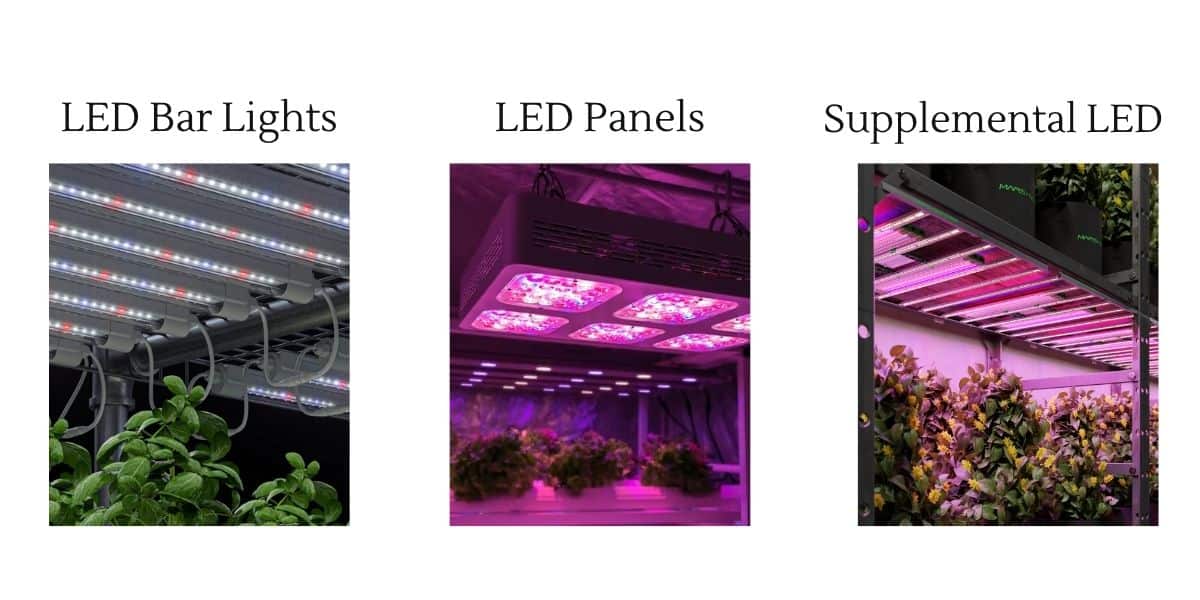
LED greenhouse lighting systems are designed to deliver controlled light intensity and spectrum for plant growth in enclosed or semi-enclosed environments.
LED bar lights consist of multiple linear light bars arranged across a frame. This structure improves light distribution and allows better penetration into plant canopies, especially in medium-sized greenhouses.
LED panels (quantum boards) are flat lighting fixtures with a compact design. They are commonly used in smaller greenhouse sections or propagation areas where uniform overhead lighting is sufficient.
Supplemental Iluminación de cultivo LED is used alongside natural sunlight. It provides additional spectrum or intensity during cloudy conditions, winter months, or in shaded greenhouse areas.
Lighting Type Comparison
| Tipo de luz | Eficiencia (µmol/J) | vida útil | Best Use Case |
| LED Bar Lights | 2.5–3.5 µmol/J | ~50,000 hrs | Medium greenhouse, full-cycle growth |
| LED Panels | 2.2–2.8 µmol/J | ~50,000 hrs | Small setups, propagation |
| Supplemental LED | 2.0–3.0 µmol/J | 40,000–50,000 hrs | Seasonal or partial lighting |
Perspectiva de decisión:
LED bar lights are generally more suitable for medium greenhouse setups due to better light distribution and canopy penetration.
Recommended Lighting by Greenhouse Size
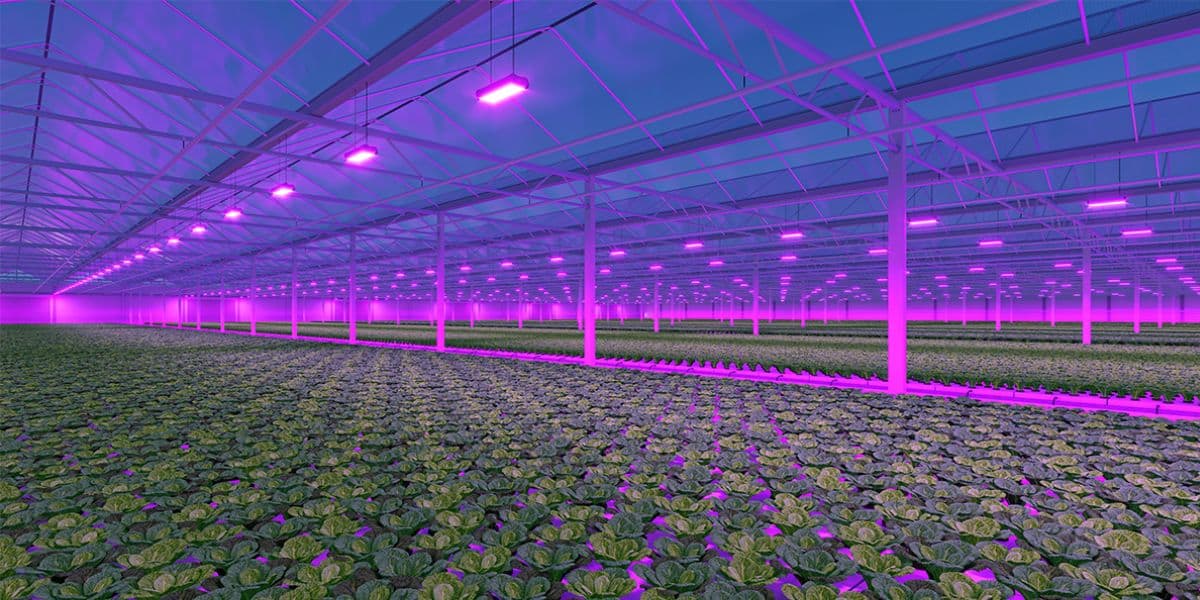
Selecting the correct lighting system depends on greenhouse size and plant density. Instead of relying on fixture wattage alone, growers should match lighting power to canopy area and crop requirements.
Small greenhouses typically require lower power systems for seedlings or light-sensitive crops. Medium-sized greenhouses require higher output systems capable of supporting full growth cycles.
Recommended Lighting by Size
| Greenhouse Size | Power Range | Coverage Area | Use Case |
| Small (1–5 m²) | 100–200W | Seedlings, herbs | Hobby or propagation |
| Medium (5–15 m²) | 200–600W | Full-cycle growth | Mixed crops |
| Dense canopy (>15 m² sections) | 600W+ | High-density crops | Commercial sections |
For example, a 10 m² greenhouse growing leafy greens may operate effectively with 300–500W of LED lighting, depending on PPFD targets and sunlight availability.
Perspectiva de decisión:
Lighting power should be calculated based on canopy area and PPFD requirements rather than relying on advertised wattage alone.
Key Technical Factors
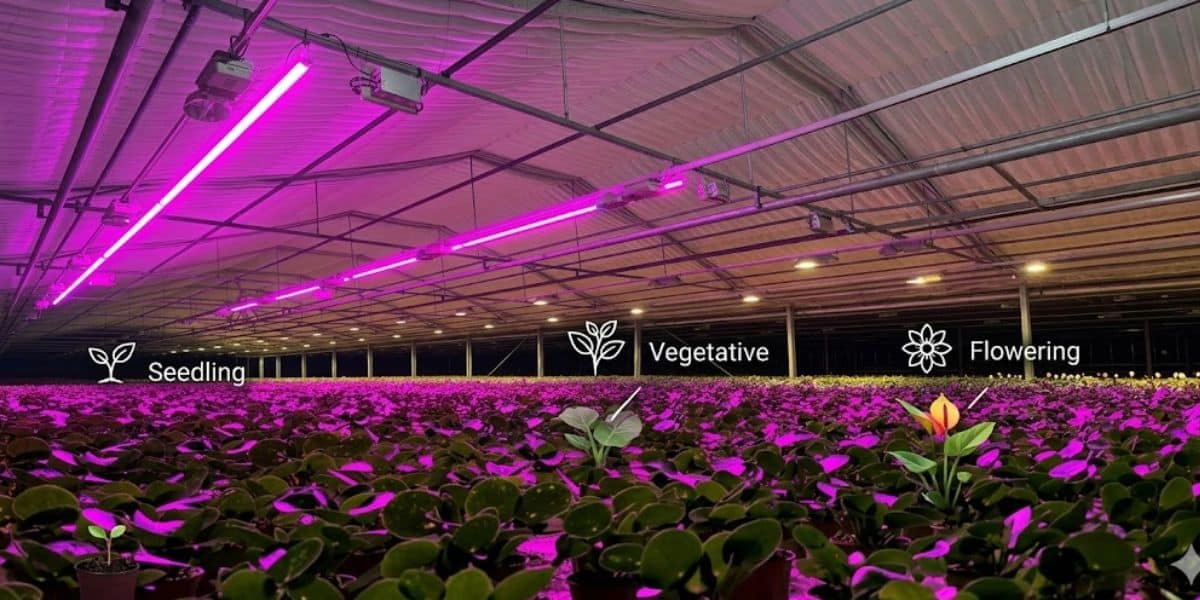
LED greenhouse lighting performance is defined by measurable technical parameters rather than general specifications.
PPFD (Photosynthetic Photon Flux Density) measures how much usable light reaches the plant canopy. It is expressed in µmol/m²/s and directly affects plant growth rates.
Light spectrum determines how plants respond to light. Full-spectrum LEDs typically cover 400–700 nm, supporting both vegetative and flowering stages.
Efficiency (µmol/J) measures how effectively electrical energy is converted into usable light. Most modern greenhouse LEDs operate between 2.2–3.5 µmol/J.
IP rating defines resistance to moisture and dust. Greenhouse lighting should have at least IP65 protection due to high humidity.
Heat output influences greenhouse temperature. LED systems produce less heat than traditional lighting but still require airflow management.
PPFD by Growth Stage
| Etapa de crecimiento | PPFD recomendado |
| plántula | 100–300 µmol/m²/s |
| vegetativo | 300–600 µmol/m²/s |
| floreciente | 600–1000 µmol/m²/s |
Maintaining uniform PPFD across the canopy ensures consistent plant development and avoids uneven growth patterns.
Perspectiva de decisión:
Lighting selection should prioritize PPFD and efficiency rather than relying only on fixture wattage.
Environmental Considerations
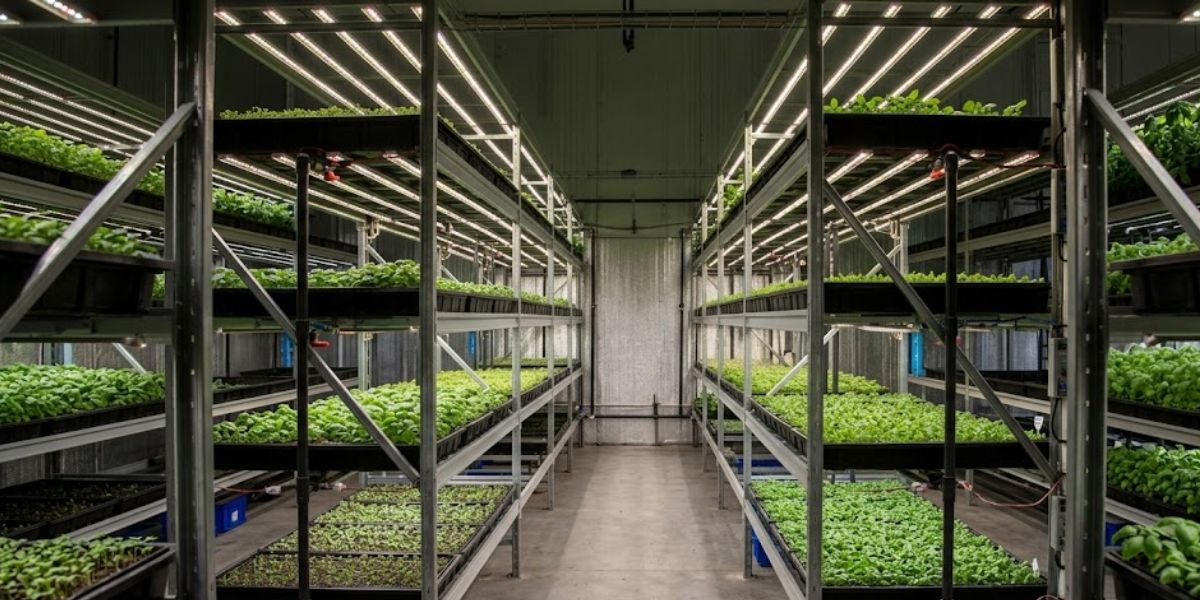
Greenhouse environments introduce specific challenges that directly affect lighting performance.
Humidity is typically high in greenhouses, which can affect electrical components if lighting systems are not properly sealed.
Airflow is necessary to manage both plant health and fixture temperature. Poor airflow can reduce LED lifespan and increase heat buildup.
Temperature fluctuates based on sunlight and external weather conditions. Lighting systems should not contribute excessive heat that disrupts plant growth.
Seasonal variation affects natural light availability. During winter or cloudy conditions, artificial lighting becomes more important for maintaining growth cycles.
Proper integration of lighting with ventilation systems helps stabilize environmental conditions and ensures consistent plant performance.
Perspectiva de decisión:
Lighting systems must be selected based on environmental conditions as well as plant requirements.
Cost vs Performance Reality
LED greenhouse lighting varies significantly in cost depending on efficiency, build quality, and performance stability.
Lower-cost LED systems often operate around 1.8–2.2 µmol/J, which may increase electricity consumption over time. Higher-efficiency systems (2.5–3.5 µmol/J) reduce long-term operating costs despite higher initial investment.
Cost vs Efficiency
| Type | Cost Range | competencia | notas |
| Budget LED | $100–200 | 1.8–2.2 µmol/J | Higher energy use |
| Mid-range LED | $200–500 | 2.2–2.8 µmol/J | Balanced performance |
| High-efficiency LED | $500+ | 2.8–3.5 µmol/J | Lower long-term cost |
Electricity cost often exceeds initial fixture cost over time, especially in continuous greenhouse operations.
Perspectiva de decisión:
Higher-efficiency lighting systems reduce operating costs and provide more stable performance over long-term use.
Common Mistakes to Avoid
What are common mistakes when choosing greenhouse LED lighting?
Common mistakes are decision errors that lead to inefficient performance, uneven plant growth, or premature equipment failure.
- Choosing lighting based only on price rather than efficiency
- Ignoring PPFD requirements for specific crops
- Selecting incorrect IP rating for humid environments
- Failing to provide adequate airflow around fixtures
- Installing lights too far or too close to the canopy
These issues often result in inconsistent yields and increased operational costs.
Selection Checklist
What should you check before selecting greenhouse LED lighting?
A selection checklist is a structured set of measurable criteria used to ensure lighting systems meet plant and environmental requirements.
- Efficiency ≥2.5 µmol/J
- PPFD matched to crop growth stage
- IP65 or higher for moisture protection
- Uniform light distribution across canopy
- Proper integration with ventilation systems
idea de narración
Selecting LED lighting for a small to medium greenhouse requires balancing plant requirements with environmental conditions and energy efficiency. The most effective systems are those that deliver consistent PPFD, operate within realistic efficiency ranges, and are designed for humid environments.
LED bar lights are typically suitable for medium greenhouse setups due to their ability to distribute light evenly across larger canopy areas. Full-spectrum panels remain useful for smaller spaces, while supplemental lighting helps maintain growth during low-light periods.
In practical terms, growers should focus on measurable factors such as PPFD, efficiency, and environmental compatibility rather than relying on product claims or wattage alone.
