
 French
  English
  Spanish
  German
  Portuguese
  Dutch
Dutch  Italian
  Thai
Thai Dimmable LED grow lights improve plant growth by allowing precise control over light intensity, ensuring plants receive the correct amount of light at each growth stage. This helps optimize photosynthesis, reduce plant stress, and improve energy efficiency.
In this article, we will explain how dimmable LED grow lights work, how they influence plant development, and how to use them effectively using measurable lighting parameters.
What Are Dimmable LED Grow Lights and How Do They Work?
Dimmable LED grow lights are defined as lighting systems that allow adjustment of light output intensity based on plant requirements.
These systems use adjustable drivers or controllers to regulate electrical input, which directly affects PPFD levels delivered to plants. Instead of operating at fixed output, dimmable lights allow gradual changes in intensity.
This flexibility allows one lighting system to support different growth stages without replacement.
What Is Light Intensity Control in Plant Growth?
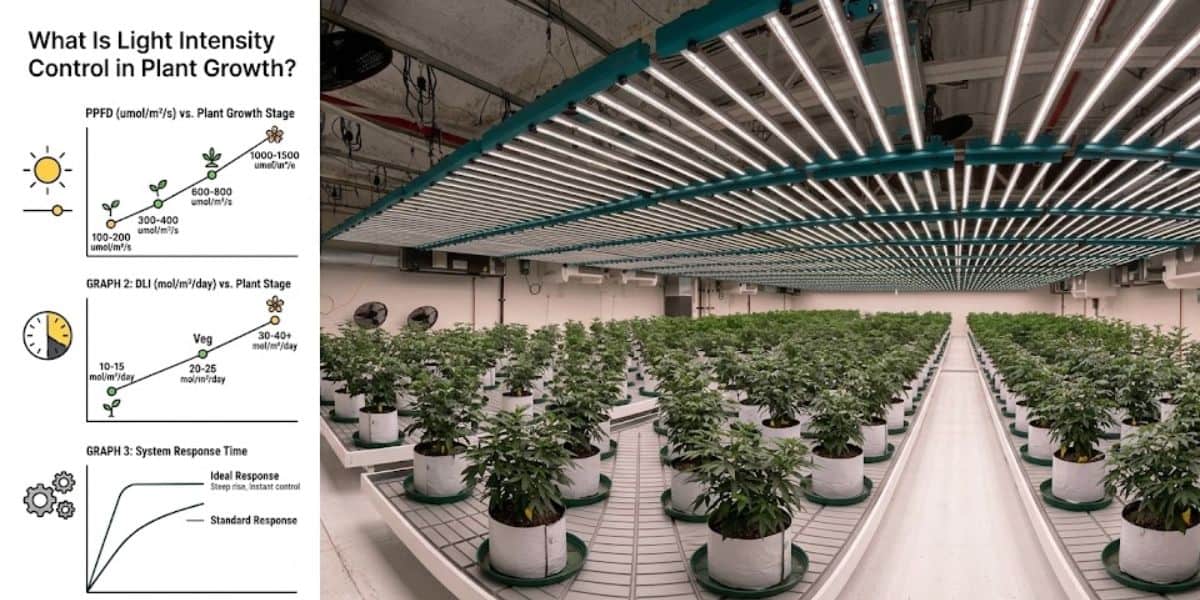
Light intensity control in plant growth is defined as adjusting the amount of light (PPFD) delivered to plants.
PPFD, or Photosynthetic Photon Flux Density, measures how many photons reach a square meter per second. This value directly affects the rate of photosynthesis.
Plants require different PPFD levels depending on their growth stage. Low intensity supports early development, while higher intensity supports flowering and biomass production.
For a broader understanding of how lighting intensity, spectrum, and system selection apply in real greenhouse environments, refer to the guide Quelles sont les meilleures options d'éclairage de serre LED pour une petite à moyenne serre ?, which explains practical lighting configurations and performance requirements.
PPFD by Growth Stage
| Stage | PPFD Range (µmol/m²/s) |
| plant | 100–300 |
| végétatif | 300–600 |
| en fleurs | 600–1000 |
Aperçu de la décision : Matching PPFD to plant growth stage improves photosynthesis efficiency and reduces stress.
How Does Dimming Adjust Light for Different Plant Growth Stages?
Dimming in LED grow lights refers to adjusting light output to match plant growth stage requirements.
Seedlings require lower light intensity because their tissues are still developing. Providing excessive light at this stage can cause stress or damage.
During vegetative growth, plants require increased light intensity to support leaf and stem development.
In the flowering stage, plants require the highest light intensity to support energy-demanding processes such as flower formation and biomass production.
Dimmable lighting allows smooth transitions between these stages without changing fixtures.
Aperçu de la décision : Stage-based light adjustment ensures plants receive the correct intensity throughout their growth cycle.
How Do Dimmable LED Grow Lights Improve Energy Efficiency and Power Usage?
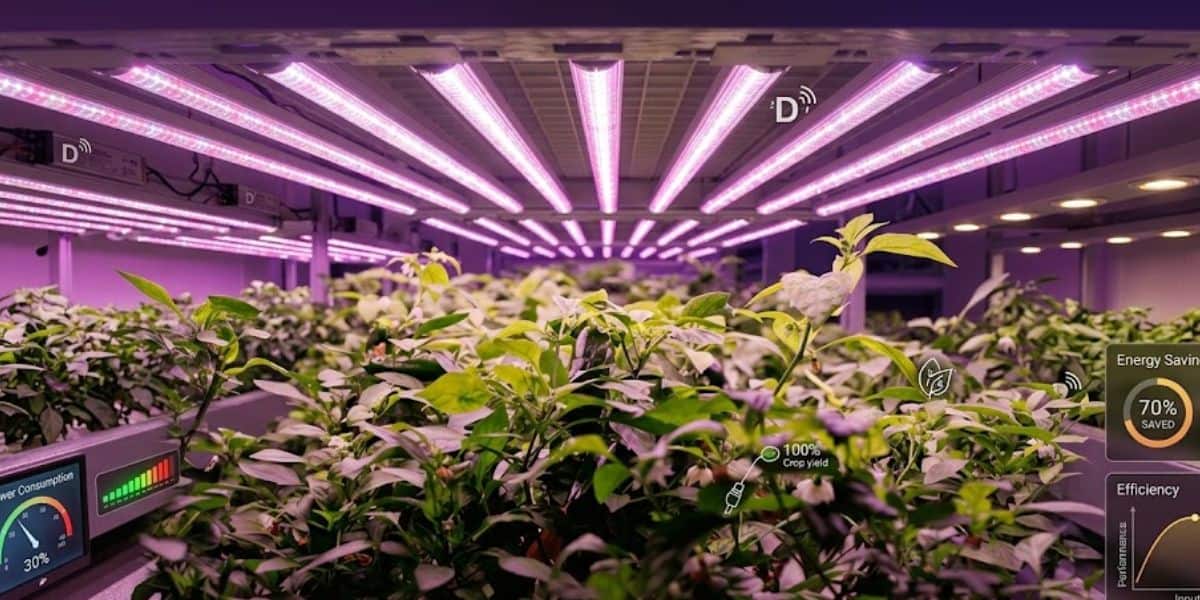
Energy efficiency in grow lighting is defined as how effectively electrical power is converted into usable light energy.
LED grow lights typically operate within a range of 2.2–3.5 µmol/J. Running lights at full output when not required increases electricity consumption without improving plant growth.
Dimming allows growers to reduce power input during early growth stages or when full intensity is not needed. This reduces unnecessary energy use while maintaining required PPFD levels.
Power Output vs Practical Effect
| Mode | Power Use | Practical Effect |
| 100% | Full | Maximum output |
| 75% | Reduced | Balanced growth |
| 50% | Lower | Energy saving |
Aperçu de la décision : Adjusting light output based on plant needs reduces electricity consumption without affecting performance.
What Light Spectrum Do Plants Need and How Does Dimming Affect It?
Light spectrum is defined as the range of wavelengths used by plants for growth.
Plants primarily respond to wavelengths between 400–700 nm. Blue wavelengths (400–500 nm) support vegetative growth by promoting compact structure. Red wavelengths (600–700 nm) support flowering and biomass production.
Full-spectrum Lampes de culture LED combine these wavelengths to support all growth stages.
Dimming does not typically change the spectrum but adjusts the total intensity of light delivered within that spectrum.
Aperçu de la décision : A stable full spectrum combined with adjustable intensity supports consistent plant development.
How Does Dimming Help Reduce Heat in Grow Lighting Systems?
Heat management in grow lighting is defined as controlling temperature produced by lighting systems.
Lighting systems generate heat as electrical energy is converted into light. Excess heat can increase canopy temperature and reduce plant efficiency.
Dimming reduces power input, which directly lowers heat output. This helps maintain stable temperature conditions in indoor or greenhouse environments.
Lower heat levels also reduce the load on ventilation and cooling systems.
Aperçu de la décision : Reducing light intensity when full output is not needed helps maintain stable growing conditions.
How Do Dimmable LED Grow Lights Improve Plant Growth Quality and Structure?
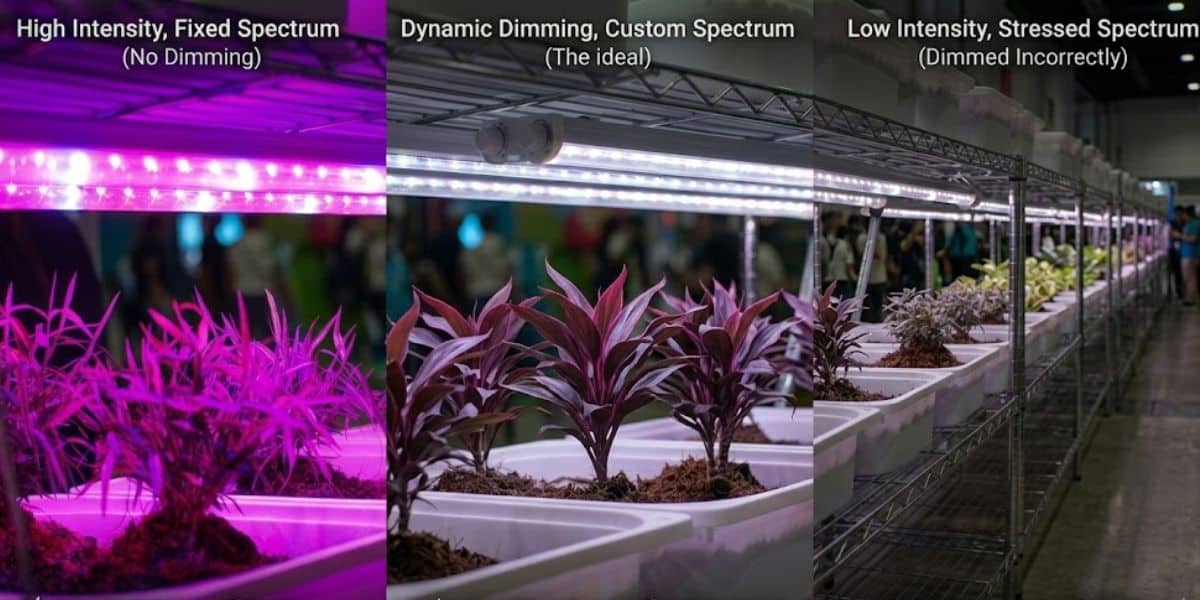
Plant growth quality is defined as the strength, structure, and uniformity of plant development.
Correct light intensity supports stronger stems and balanced leaf growth. Insufficient light can cause stretching, while excessive light can damage plant tissues.
Dimmable systems allow precise adjustment, resulting in more uniform plant height and canopy distribution.
This uniformity is important for controlled growing environments where consistency is required.
Decision Insight: Controlled light intensity improves plant structure and ensures consistent growth across the canopy.
What Are the Limitations of Dimmable LED Grow Lights?
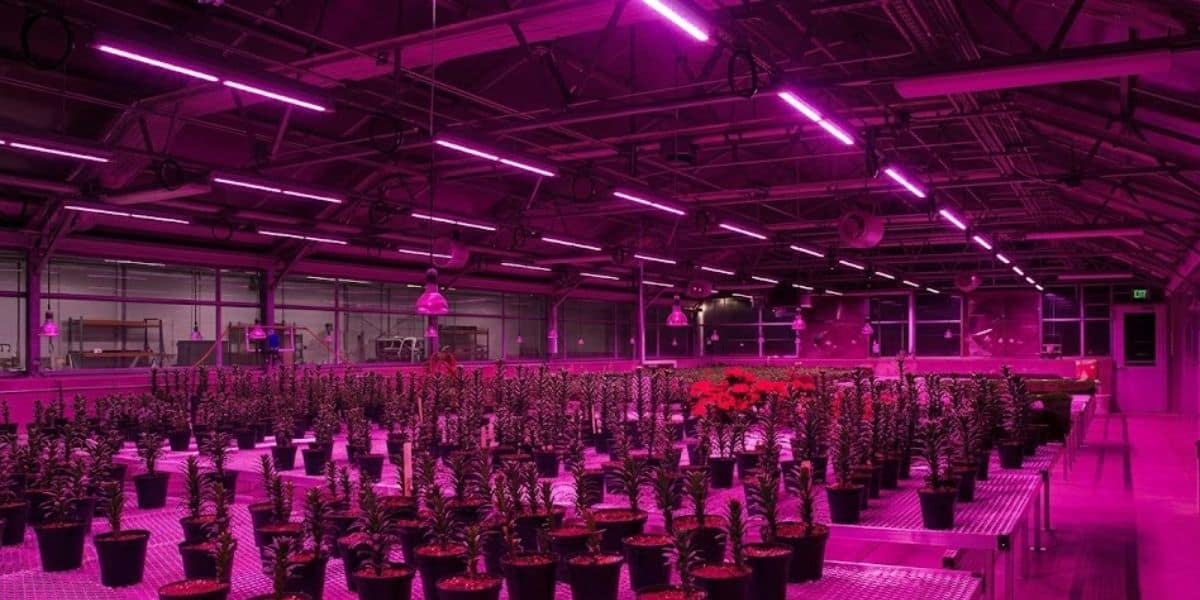
Limitations of dimmable LED grow lights refer to conditions where dimming alone does not improve performance.
Not all LED grow lights support dimming functionality. Some systems operate only at fixed output levels.
Dimming also does not replace proper lighting setup. Incorrect fixture placement or uneven light distribution can still reduce effectiveness.
In addition, improper use of dimming, such as maintaining low intensity during high-demand stages, can limit plant growth.
Decision Insight: Dimming improves flexibility but must be used alongside proper setup and monitoring.
What Common Mistakes Reduce the Effectiveness of Dimmable Grow Lights?
Common mistakes are defined as incorrect usage practices that reduce lighting efficiency and plant performance.
- Using low light intensity during flowering stage
- Ignoring proper distance between lights and plants
- Relying only on dimming without adjusting setup
- Failing to monitor PPFD levels
These mistakes can lead to inconsistent growth and reduced yields.
What Is the Correct Way to Use Dimmable LED Grow Lights?
A usage checklist is defined as a structured method to ensure proper operation of dimmable grow lighting systems.
- Adjust light intensity according to plant growth stage
- Monitor PPFD at canopy level
- Maintain proper distance between fixture and plants
- Ensure adequate airflow and temperature control
conclusion
Dimmable LED grow lights improve plant growth by providing adjustable light intensity that matches plant needs at each stage of development.
This flexibility allows better control over photosynthesis, reduces unnecessary energy use, and improves environmental stability.
By maintaining correct PPFD levels and stable conditions, growers can achieve consistent plant development and more predictable results.
In practical use, dimmable systems provide a controlled and efficient approach to indoor and greenhouse cultivation.
