
 Italian
  English
  Spanish
  French
  German
  Portuguese
  Dutch
Dutch  Thai
Thai Lettuce is often described as a low-light crop, but that label is too vague for an indoor farm. A newly emerged plug and a harvest-ready head do not need the same light intensity, and two cultivars can react differently to the same daily dose. The useful approach is to manage both PPFD—the light arriving at the canopy each second—and dli—the total photosynthetic light delivered over the day.
This guide gives indoor-farm operators practical starting ranges for each lettuce growth stage, shows how to convert PPFD and photoperiod into DLI, and explains how to tune a recipe without treating any number as universal.
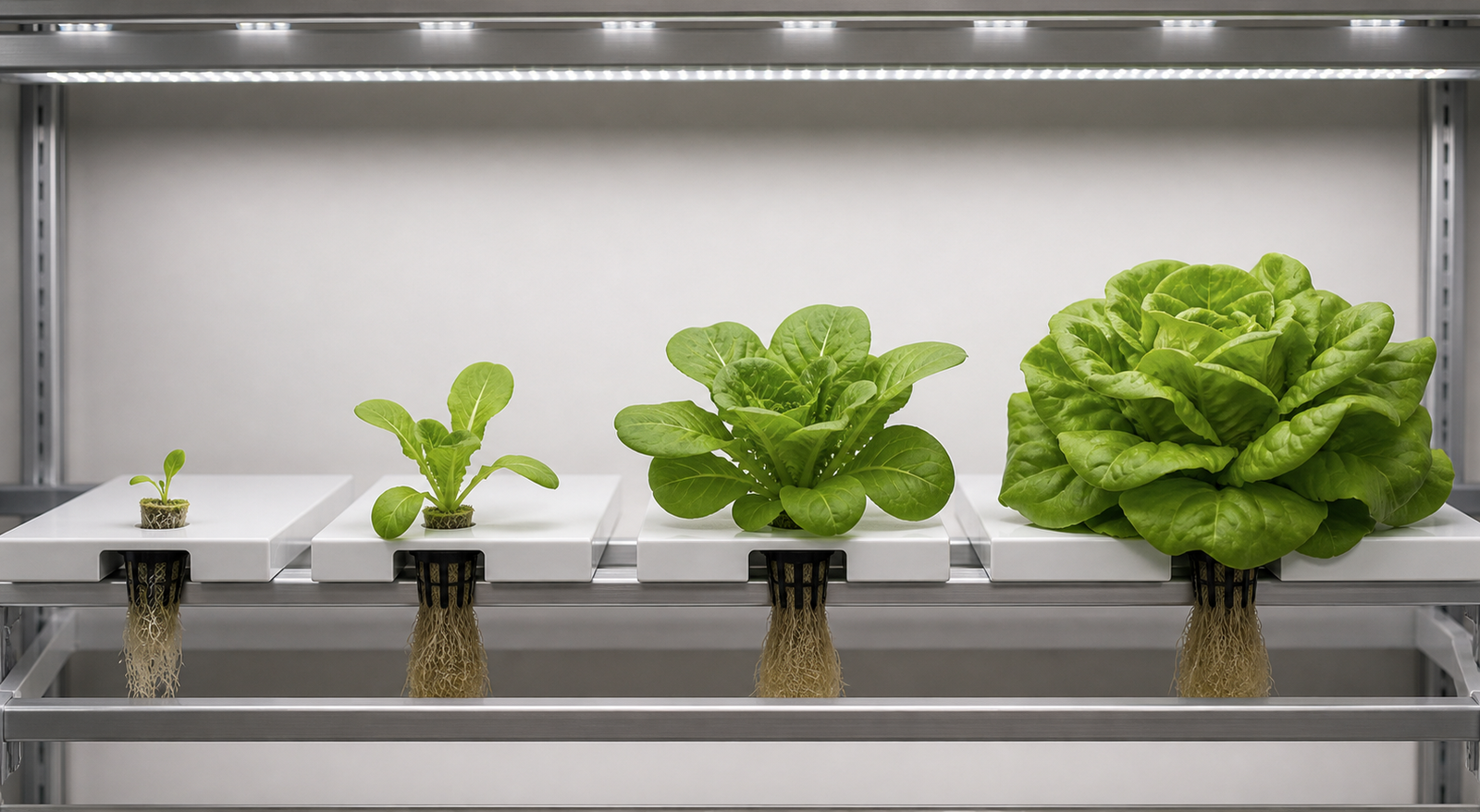
PPFD and DLI: the two numbers that define a light recipe
PPFD, measured in µmol/m²/s, is an instantaneous canopy-level measurement. It helps you set fixture height, dimming level, and spacing. DLI, measured in mol/m²/day, adds up those photons over the photoperiod. A rack can have the correct PPFD but still deliver too little or too much daily light if the timer is wrong.
The conversion for a constant output is:
For example, 220 µmol/m²/s for 16 hours gives 12.7 mol/m²/day.
That relationship gives operators two levers. To reach roughly the same DLI, you can use a higher PPFD for fewer hours or a lower PPFD for longer. The crop response is not always identical, however. Research with lettuce has shown that longer photoperiods at lower PPFD can improve light interception and biomass at the same DLI, so avoid assuming that every mathematically equivalent schedule is biologically equivalent. Kingrowlight’s practical PPF, PPFD, and DLI guide explains the measurement terms in more detail.
For useful experimental context, a controlled study of lettuce and mizuna compared 10- to 20-hour photoperiods while holding DLI at 16 mol/m²/day, and a separate romaine lettuce study tested combinations from 9.2 to 17.3 mol/m²/day. These experiments are valuable reference points, but their cultivars and controlled conditions are not substitutes for an on-farm trial.
Practical lettuce PPFD and DLI targets by growth stage
The following ranges are conservative commissioning points for sole-source indoor production. They are not cultivar guarantees. Begin near the lower-middle of the band, measure the whole canopy, and increase only when roots, temperature, airflow, irrigation, and calcium transport are stable.
| palcoscenico | Typical timing | Starting PPFD | Starting DLI | What to watch |
|---|---|---|---|---|
| Germination / emergence | Days 0–3 | 50–100 µmol/m²/s | 3–6 mol/m²/day | Uniform emergence; no drying of plugs |
| Seedling / plug | About days 3–14 | 100–180 µmol/m²/s | 6–10 mol/m²/day | Compact leaves, strong roots, no stretch |
| Post-transplant establishment | First 5–7 days after transplant | 140–220 µmol/m²/s | 8–12 mol/m²/day | Fast root recovery; steady leaf expansion |
| Vegetative bulking | Main production period | 180–280 µmol/m²/s | 10–16 mol/m²/day | Fresh mass, uniform diameter, leaf color |
| Final finish / preharvest | Final 3–7 days | 200–300 µmol/m²/s | 12–17 mol/m²/day | Tipburn, texture, red pigmentation, head density |
These bands overlap deliberately. A vigorous romaine cultivar in a well-controlled room may use the upper end, while a compact butterhead in warmer, humid conditions may perform better lower. Studies on indoor romaine have produced strong fresh weight between roughly 11.5 and 17.3 mol/m²/day, but cultivar-specific yield and sensory responses differed. That is why a stage recipe should be validated against marketable yield, not copied from a single trial.
Worked photoperiod examples for an indoor lettuce rack
Suppose the production target is 14 mol/m²/day during vegetative bulking. Rearranging the formula gives the average PPFD needed:
- 14-hour photoperiod: about 278 µmol/m²/s
- 16-hour photoperiod: about 243 µmol/m²/s
- 18-hour photoperiod: about 216 µmol/m²/s
- 20-hour photoperiod: about 194 µmol/m²/s
A longer schedule can reduce the required instantaneous intensity and may improve fixture utilization, but it also changes room heat-load timing and leaves a shorter dark period. A practical baseline is often 16–18 hours of light, followed by adjustment from crop data. Do not jump directly to continuous lighting just because it lowers PPFD; cultivar response, physiology, facility controls, and operating strategy need validation.
Measure average PPFD—not the brightest point
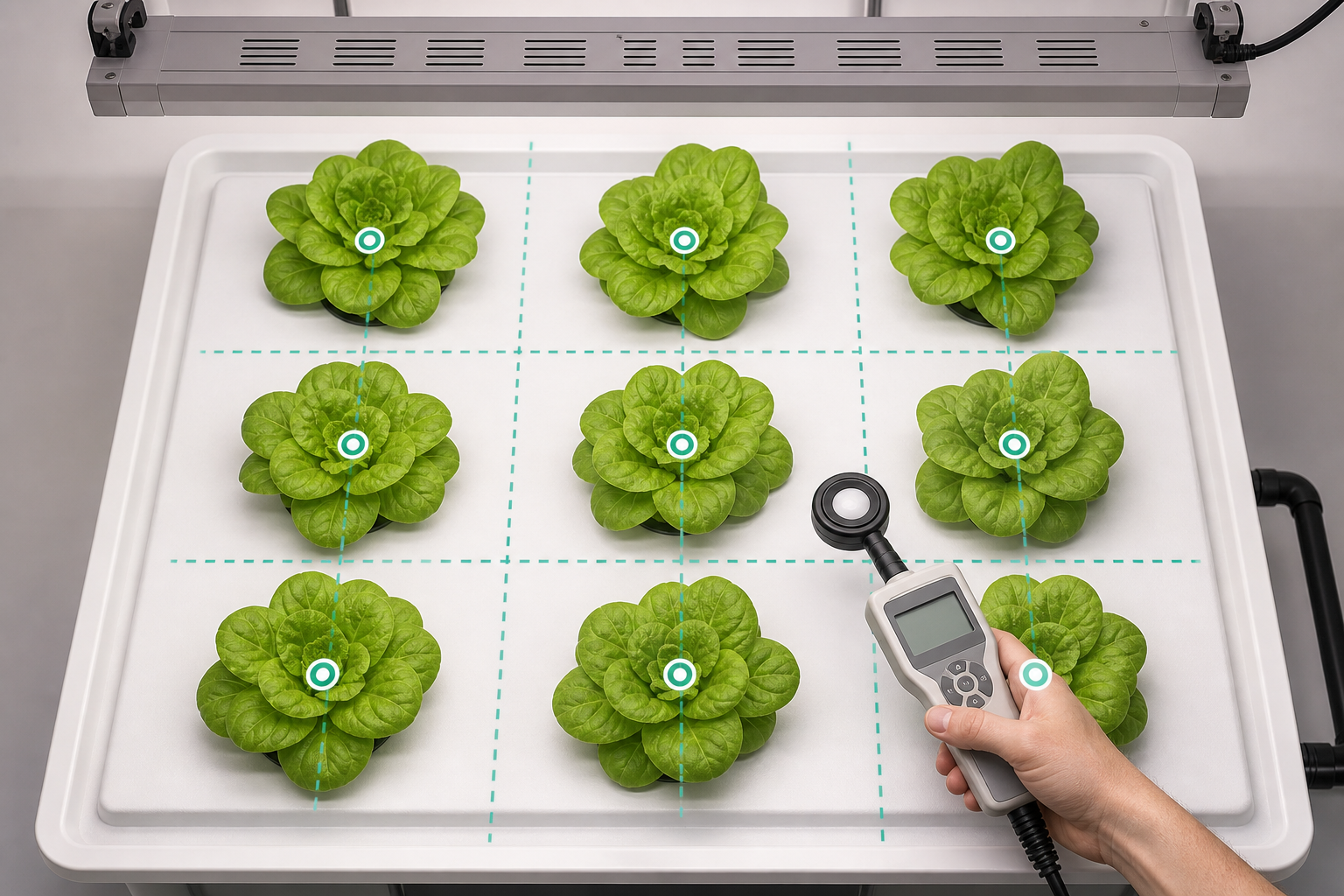
Fixture specifications and center readings do not tell you what the entire crop receives. Measure at plant-canopy height with a quantum sensor after the system has reached normal operating conditions. On each representative tray, record a grid that includes corners, edges, and the center, then calculate:
- Average PPFD for the DLI calculation.
- Minimum and maximum PPFD to locate weak zones and hotspots.
- Uniformity ratio—minimum divided by average—to compare rack performance.
Repeat the map after changing fixture height, dimming, tray spacing, or crop density. As leaves expand, the measurement plane rises and adjacent plants begin intercepting light differently. The broader PPFD guide by crop covers canopy measurements and common intensity mistakes.
Why the same DLI can produce different lettuce
Light does not operate separately from the rest of the room. Increasing DLI accelerates growth only while carbon dioxide, temperature, humidity, airflow, root-zone oxygen, water, and nutrients can support the extra photosynthesis. If those controls fall behind, more light can reduce marketable quality.
Cultivar and market type
Romaine, butterhead, crisphead, oakleaf, and red-leaf cultivars differ in architecture, pigmentation, head density, and susceptibility to physiological disorders. Red lettuce may need a stronger finishing strategy to develop market color, while a tipburn-sensitive butterhead may need a gentler peak DLI. Use the seed supplier’s guidance and validate each cultivar in your own system.
Tipburn is a whole-environment warning
Tipburn is associated with inadequate calcium reaching rapidly expanding inner leaves. High growth rates can increase risk, but simply lowering light or adding calcium does not diagnose the cause. Check airflow through the inner canopy, humidity and transpiration behavior, root-zone conditions, temperature, and growth rate together. Increase light in small steps and inspect the newest leaves, not only the outer canopy.
Spacing changes the canopy
Young plants expose much of the tray surface; mature plants overlap and create a different light field. A recipe that works at one density may not transfer to another. Measure after final spacing and track edge-to-center harvest variation. Uniformity is particularly important in multi-tier systems where a small hotspot repeats across every level.
S-series Grow Light Bars for shallow lettuce racks
For multilayer leafy-green production, a slim, dimmable bar layout can help distribute moderate PPFD across a shallow canopy while leaving room for airflow and irrigation access. Review the available dimensions, PPFD maps, mounting options, and control requirements against your actual rack geometry.
For application planning beyond a single fixture, see Kingrowlight’s indoor leafy-green lighting solutions. Fixture selection should be based on the required average PPFD, uniformity, rack clearances, control method, and measured heat load—not wattage alone.
A safer commissioning method for a new cultivar
- Choose a conservative starting recipe. Begin near the lower-middle of the appropriate stage band.
- Map the rack. Confirm average, minimum, and maximum PPFD at canopy height.
- Change one variable at a time. Adjust PPFD or photoperiod, not both, so the result is interpretable.
- Use small steps. Increase DLI by roughly 1–2 mol/m²/day per trial rather than making a large jump.
- Record marketable outcomes. Track days to harvest, fresh mass, head diameter, uniformity, tipburn incidence, color, texture, and energy used per marketable kilogram.
- Replicate. Compare more than one tray and repeat the result before deploying the recipe across the farm.
This process turns a published range into an operating recipe. The “best” light level is not necessarily the treatment with the greatest fresh mass; it is the one that gives reliable marketable quality at an acceptable cycle time and energy cost.
Frequently asked questions
What PPFD should lettuce receive indoors?
A useful starting range is about 100–180 µmol/m²/s for established seedlings and 180–280 µmol/m²/s for the main vegetative stage. Harvest finishing may reach 200–300 µmol/m²/s when the cultivar and environment tolerate it. Always calculate the corresponding DLI.
What DLI is suitable for indoor lettuce?
Many indoor lettuce programs operate broadly around 10–17 mol/m²/day after establishment, with lower values for plugs. Cultivar, stage, temperature, airflow, and production goal determine where within that range a crop performs best.
Is 24-hour light best for lettuce?
Not automatically. Some controlled studies report benefits from very long photoperiods at lower PPFD, but continuous lighting should be tested as a specific system and cultivar strategy. A 16–18-hour schedule is a more conservative starting point for commercial commissioning.
How often should PPFD be measured?
Measure when commissioning a rack and after any meaningful change to fixture height, dimming, spacing, or canopy position. Recheck representative zones periodically because dust, component aging, and operational changes can alter output.
Build the recipe around the crop, not a single number
Successful lettuce lighting is a controlled progression: gentle light for emergence, a measured increase through establishment, and a stable DLI during bulking and finishing. Use average canopy PPFD, keep a deliberate photoperiod, and treat the stage table as a starting range. The final recipe should come from replicated crop results for each cultivar and rack—not from the brightest point on a fixture map.
Planning a new lettuce rack or upgrading an uneven installation? Contact Kingrowlight with the rack dimensions, target cultivar, canopy clearance, and required PPFD so the lighting layout can be evaluated around the real production system.
