
 Portuguese
  English
  Spanish
  French
  German
  Dutch
Dutch  Italian
  Thai
Thai A grower installs a high-quality LED fixture, hangs it at the manufacturer’s recommended height, follows the timer schedule exactly, and still ends up with stretched seedlings, weak lettuce heads, or cannabis flowers that never fully bulk up. The problem is usually not the fixture itself. The real issue is that the PPFD reaching the canopy is wrong for that specific crop and growth stage.
PPFD measures how many photosynthetically active photons hit one square meter of plant canopy every second, expressed as µmol/m²/s.
This guide gives you exact PPFD targets by crop and growth stage, practical DLI calculations, and real-world lighting strategies commercial growers use to maximize yield without wasting electricity or stressing plants.
The difference between healthy growth and disappointing harvests often comes down to one number.
What Is PPFD and Why It Matters More Than Watts or Lumens
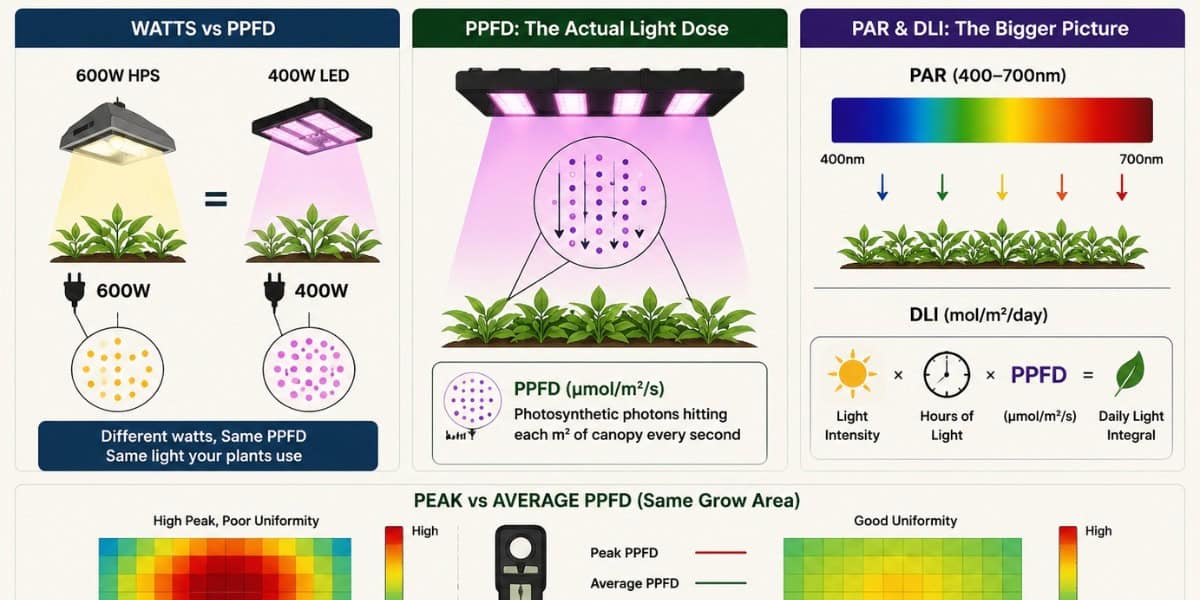
Most indoor growers start by comparing watts because wattage looks simple. A fixture labeled 720W feels more powerful than one labeled 480W. The problem is that plants do not consume watts. Plants consume photons. A modern 400W LED fixture can deliver the same canopy-level PPFD as a 600W HPS fixture while using far less electricity because LED efficiency is dramatically higher.
That is why commercial growers stopped evaluating lights based purely on power consumption years ago. The real question is not how much electricity the fixture uses. The real question is how many usable photons actually reach the crop canopy.
PPFD answers that question directly. When a grower measures 600 µmol/m²/s at canopy level, that means the plants are receiving 600 micromoles of photosynthetically active photons every second across each square meter. That measurement reflects the actual light dose plants can use for photosynthesis.
PAR becomes useful when growers evaluate spectrum quality. A fixture can produce strong intensity, but if too much output falls outside the photosynthetically active radiation range of 400 to 700nm, plants cannot efficiently use that energy. This is why modern horticultural LED fixtures are designed around PAR efficiency rather than visual brightness.
PPFD becomes useful when growers adjust hanging height, dimming, fixture spacing, and canopy management. Two fixtures with identical wattage can produce completely different PPFD distribution patterns. One may create a hot spot directly under the fixture while starving the canopy edges. Another may deliver lower peak intensity but better uniformity across the entire growing area.
DLI becomes important because plants respond to total daily light accumulation, not just momentary intensity. A crop receiving 400 µmol/m²/s for 18 hours may outperform a crop receiving 700 µmol/m²/s for only 8 hours because the total photon accumulation over the day is higher.
The table below shows how PAR, PPFD, and DLI work together in real indoor cultivation.
| Term | Full Name | What It Measures | Unit | Practical Use |
| PAR | Photosynthetically Active Radiation | Light wavelength range plants use | 400 to 700nm | Wrong spectrum = wasted energy |
| PPFD | Photosynthetic Photon Flux Density | Photon intensity at canopy level | µmol/m²/s | The actual light dose your plant receives |
| DLI | Daily Light Integral | Total light accumulated per day | mol/m²/day | Your plant’s daily light budget |
Most grow light advertisements highlight peak PPFD directly under the fixture center. Commercial growers care far more about average PPFD across the full canopy footprint. A fixture showing 1500 µmol/m²/s in the center but only 500 at the edges creates uneven growth, inconsistent flowering, and lower harvest quality. Real PPFD maps reveal the numbers that actually matter.
The PPFD Scale Where Does Your Crop Sit?
One of the fastest ways to damage indoor crops is treating every plant as though it needs the same amount of light. A lettuce crop and a flowering cannabis canopy operate in completely different lighting environments. Trying to grow both under identical PPFD levels guarantees poor results for at least one of them.
Leafy greens evolved to tolerate moderate light conditions and short production cycles. Fruiting crops like tomatoes and peppers demand far higher photon intensity because they are simultaneously building structure, supporting transpiration, producing flowers, and developing fruit mass. Cannabis during peak flower pushes even further because dense flower development requires extremely high photosynthetic activity.
The table below gives realistic PPFD categories growers can use as a baseline before adjusting for growth stage, environment, and cultivar response.
| Light Category | PPFD Range µmol/m²/s | Typical Crops |
| Very Low Light | Under 100 | Ferns, peace lily, pothos, mosses |
| Low Light | 100 to 250 | Seedlings, clones, microgreens |
| Medium Light | 250 to 500 | Lettuce, spinach, kale, most herbs |
| High Light | 500 to 800 | Tomatoes, peppers, cucumbers, strawberries |
| Very High Light | 800 to 1500 | Cannabis flowering, high-yield fruiting crops with CO2 supplementation |
These ranges are starting points, not fixed rules. Temperature, humidity, CO2 concentration, photoperiod, cultivar genetics, and nutrient availability all affect how much PPFD plants can actually use. Cannabis grown at 1200 µmol/m²/s without CO2 supplementation above roughly 800 ppm often experiences diminishing returns, leaf stress, and environmental instability. More light only increases yield when the rest of the environment can support higher photosynthetic demand.
PPFD Requirements by Crop Exact Targets for What You Are Growing
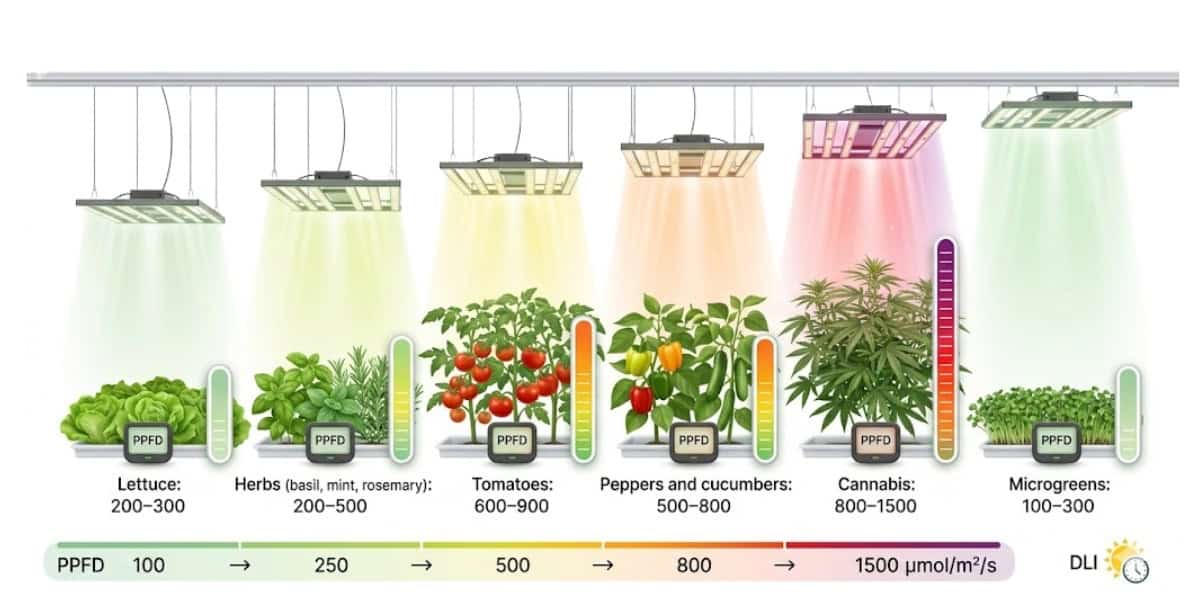
Indoor crops respond differently to light intensity because each species evolved under different environmental pressures. The following sections break down realistic PPFD targets by growth stage, practical DLI ranges, and the common mistakes growers make with each crop.
Lettuce and Leafy Greens The Most Forgiving Crop, Still Has Limits
Lettuce is one of the easiest crops to grow indoors, but it is also one of the most commonly over-lit crops in vertical farming. Many growers assume more PPFD automatically means faster growth. Instead, they trigger tip burn, edge necrosis, and poor head formation. In controlled environment agriculture research, lettuce tip burn is strongly associated with excessive DLI above roughly 17 mol/m²/day, especially in butterhead and bibb cultivars.
Commercial lettuce production typically performs best between 200 and 300 µmol/m²/s under extended photoperiods. Research from indoor farm studies showed lettuce grown under 16-hour photoperiods at approximately 170 µmol/m²/s produced around 30 percent higher yield compared to 12-hour schedules at the same intensity because the plants accumulated greater total daily photons without excessive stress.
The table below shows practical lettuce PPFD targets by stage.
| estágio de crescimento | PPFD Target µmol/m²/s | DLI Target mol/m²/day | Photoperiod Hours |
| Germination | 50 to 100 | 3 to 5 | 16 to 18 |
| plântula | 100 to 200 | 8 to 12 | 16 to 18 |
| vegetativo | 200 to 400 | 12 to 17 | 16 to 18 |
| Harvest ready | 250 to 450 | 14 to 17 | 16 to 18 |
Above a DLI of roughly 17 mol/m²/day, tip burn risk rises sharply in many commercial lettuce varieties. Growers often mistake this for calcium deficiency and increase nutrient concentration when the actual problem is excessive transpiration pressure caused by too much light.
Kingrowlight S-series and D-series Grow Light Bars work especially well for lettuce because they distribute medium PPFD evenly across vertical farming racks without creating intense center hotspots.
Herbs Basil, Mint, Rosemary, Cilantro, Thyme
Herbs are frequently grouped together under generic “medium-light crop” recommendations, but herb species respond very differently to PPFD. Rosemary and thyme evolved in dry Mediterranean climates with intense sunlight and naturally tolerate higher photon density. Basil, cilantro, and mint behave differently under aggressive lighting strategies.
Light intensity directly influences oil production in aromatic herbs. Basil exposed to higher PPFD often develops stronger aroma, thicker leaves, and greater essential oil concentration. There is a limit, though. Excessive PPFD combined with poor airflow can lead to leaf curling and stress responses.
The table below shows realistic PPFD targets by herb type.
| Herb | Optimal PPFD µmol/m²/s | DLI Target | notas |
| Basil | 200 to 350 | 12 to 16 | High DLI increases leaf oil content |
| Mint | 150 to 300 | 10 to 14 | Too much light causes leaf curl |
| Rosemary | 300 to 500 | 15 to 20 | Handles high PPFD well |
| Thyme | 300 to 500 | 15 to 20 | Similar to rosemary |
| Cilantro | 150 to 250 | 10 to 14 | Bolts quickly under high PPFD |
| Parsley | 200 to 350 | 12 to 16 | Consistent medium light |
Vertical farm operators growing mixed herb racks often divide crops into separate PPFD zones rather than lighting all trays equally. That improves uniformity, flavor consistency, and harvest timing.
Tomatoes The Most Demanding Vegetable Crop
Tomatoes place extreme demands on indoor lighting systems because the plant continuously balances vegetative growth, flowering, and fruit production at the same time. Weak lighting creates elongated stems, poor flower set, low sugar development, and reduced fruit weight.
Dutch greenhouse research consistently targets DLI levels between 20 and 30 mol/m²/day for commercial tomato production. That range supports strong photosynthetic activity without excessive stress when environmental conditions remain stable.
The table below shows realistic PPFD progression for tomatoes.
| ato | PPFD µmol/m²/s | DLI mol/m²/day | fotoperíodo |
| plântula | 200 to 300 | 10 to 14 | 16 hours |
| Early vegetative | 300 to 500 | 14 to 18 | 16 to 18 hours |
| Late vegetative | 400 to 600 | 17 to 22 | 16 to 18 hours |
| flor | 600 to 800 | 20 to 28 | 16 to 18 hours |
| Fruiting | 700 to 900 | 22 to 30 | 16 to 18 hours |
Commercial tomato growers often use high-output fixtures like the Kingrowlight LED dobrável LED cresce luz because tomatoes need both intensity and uniform canopy penetration. Uneven PPFD leads directly to inconsistent fruit ripening and lower overall marketable yield.
Peppers and Cucumbers
Peppers and cucumbers require similar light levels to tomatoes, but cucumbers generally tolerate higher PPFD during aggressive fruiting phases because of their rapid vegetative expansion and heavy water demand. Peppers are slightly more sensitive to heat stress under excessive photon density.
The table below provides practical stage targets for both crops.
| Crop Stage | Pepper PPFD µmol/m²/s | Cucumber PPFD µmol/m²/s | DLI Target |
| plântula | 200 to 300 | 200 to 300 | 10 to 14 |
| vegetativo | 400 to 600 | 400 to 600 | 16 to 22 |
| flor | 500 to 700 | 600 to 800 | 20 to 28 |
| Fruiting | 600 to 800 | 700 to 900 | 22 to 30 |
Growers running cucumbers indoors frequently underestimate how quickly canopy density increases. Once leaves overlap heavily, lower canopy PPFD drops dramatically. Linear bar fixtures help maintain more even penetration through dense growth.
Cannabis Full Stage Breakdown Including CO2 Interaction
Cannabis has one of the widest usable PPFD ranges of any indoor crop. Seedlings can bleach under 400 µmol/m²/s, while mature flowering plants in optimized rooms may tolerate 1500 µmol/m²/s with proper CO2 enrichment and environmental control.
The limiting factor above roughly 800 µmol/m²/s is usually not the fixture. It is CO2 availability. Research and commercial cultivation data consistently show that most cannabis cultivars begin reaching light saturation around 800 to 1000 µmol/m²/s under ambient CO2 conditions. Beyond that point, additional photons generate diminishing returns unless CO2 supplementation, VPD, irrigation, and temperature are also optimized.
The table below shows realistic cannabis targets by stage.
| ato | PPFD µmol/m²/s | DLI mol/m²/day | CO2 Recommended | notas |
| Germination | 100 to 200 | 5 to 8 | Ambient | Keep distance high |
| plântula | 200 to 400 | 10 to 15 | Ambient | Watch for bleaching |
| Early vegetative | 400 to 600 | 20 to 25 | 400 to 600 ppm | Ramp up slowly |
| Late vegetative | 600 to 800 | 25 to 30 | 600 to 800 ppm | Push for density |
| Early flowering | 800 to 1000 | 30 to 40 | 800 to 1200 ppm | Initiate with 12/12 |
| Peak flowering | 1000 to 1500 | 40 to 65 | 1000 to 1500 ppm | Max yield requires CO2 |
High-output fixtures like the Kingrowlight Spider LED Grow Light and Linear LED Grow Light are designed specifically for these PPFD ranges because flowering cannabis requires both intensity and canopy uniformity to avoid lower bud degradation.
Microgreens High Turnover, Low PPFD
Microgreens have short growth cycles, usually between 7 and 14 days, which changes how growers approach lighting strategy. Many new growers assume high PPFD accelerates production. Instead, excessive intensity often creates uneven elongation, moisture stress, and inconsistent coloration.
Most microgreens perform well between 100 and 300 µmol/m²/s with DLI targets between 6 and 12 mol/m²/day. Radish and sunflower varieties generally tolerate the higher end of the range, while brassica microgreens often perform better under gentler lighting.
Because microgreen trays are stacked densely in vertical systems, fixture uniformity matters more than extreme intensity. Kingrowlight D-series Grow Light Bars are commonly used in these environments because they maintain stable medium-low PPFD across shallow tray canopies.
The Master PPFD Reference Table Every Crop in One Place
Commercial growers rarely memorize every crop-specific PPFD target. Most operations rely on quick-reference charts during environmental planning, fixture selection, and room setup. The table below consolidates practical PPFD ranges growers can use immediately.
| Crop | plântula | vegetativo | Flowering/Fruiting | DLI Target |
| alface | 100 to 200 | 250 to 400 | 350 to 500 | 12 to 17 |
| Spinach/Kale | 100 to 200 | 200 to 400 | 350 to 500 | 12 to 17 |
| Basil | 100 to 200 | 200 to 350 | 250 to 400 | 12 to 16 |
| Rosemary | 150 to 250 | 300 to 450 | 350 to 500 | 15 to 20 |
| tomate | 200 to 300 | 400 to 600 | 600 to 900 | 20 to 30 |
| Pepper | 200 to 300 | 400 to 600 | 500 to 800 | 18 to 28 |
| pepino | 200 to 300 | 400 to 600 | 500 to 800 | 18 to 28 |
| Strawberry | 150 to 250 | 300 to 500 | 400 to 700 | 15 to 25 |
| Cannabis | 200 to 400 | 400 to 800 | 800 to 1500 | 40 to 65 flowering |
| Microgreens | 100 to 200 | 150 to 300 | Not applicable | 6 to 12 |
DLI The Calculation Most Growers Skip That Determines Everything
Many growers obsess over PPFD while ignoring the total amount of light plants receive over an entire day. That creates major mistakes in indoor cultivation planning. A crop receiving 600 µmol/m²/s for 8 hours accumulates less total light than one receiving 400 µmol/m²/s for 16 hours.
DLI solves that problem because it measures total daily photon accumulation.
The formula is straightforward:
DLI = PPFD × photoperiod hours × 0.0036
Commercial growers constantly adjust this relationship depending on electricity pricing, natural sunlight contribution, and environmental conditions.
A flowering tomato crop targeting 25 mol/m²/day under a 16-hour photoperiod requires approximately:
25 ÷ 16 ÷ 0.0036 = 434 µmol/m²/s
If the grower extends the photoperiod to 18 hours:
25 ÷ 18 ÷ 0.0036 = 386 µmol/m²/s
This is why greenhouse growers reduce supplemental lighting intensity during brighter seasons. Natural sunlight already contributes part of the DLI target.
The table below provides fast DLI reference values growers can use without recalculating manually.
| PPFD µmol/m²/s | 12 Hours | 14 Hours | 16 Hours | 18 Hours | 20 Hours |
| 100 | 4.3 | 5.0 | 5.8 | 6.5 | 7.2 |
| 200 | 8.6 | 10.1 | 11.5 | 13.0 | 14.4 |
| 300 | 13.0 | 15.1 | 17.3 | 19.4 | 21.6 |
| 400 | 17.3 | 20.2 | 23.0 | 25.9 | 28.8 |
| 500 | 21.6 | 25.2 | 28.8 | 32.4 | 36.0 |
| 600 | 25.9 | 30.2 | 34.6 | 38.9 | 43.2 |
| 800 | 34.6 | 40.3 | 46.1 | 51.8 | 57.6 |
| 1000 | 43.2 | 50.4 | 57.6 | 64.8 | 72.0 |
Values are expressed in mol/m²/day.
Five PPFD Mistakes That Are Silently Damaging Your Plants
Running Maximum PPFD at Every Stage
Seedlings exposed immediately to flowering-level intensity often bleach, stall, or develop distorted growth. Young plants have limited photosynthetic capacity and underdeveloped root systems. Commercial growers gradually ramp intensity upward over one to two weeks instead of blasting seedlings with maximum fixture output.
Measuring Only at the Center of the Canopy
A single PAR reading taken directly under the fixture creates misleading data. Many fixtures lose 30 to 50 percent PPFD toward canopy edges. Commercial growers measure across multiple canopy points because average PPFD determines yield consistency.
Ignoring Light Uniformity
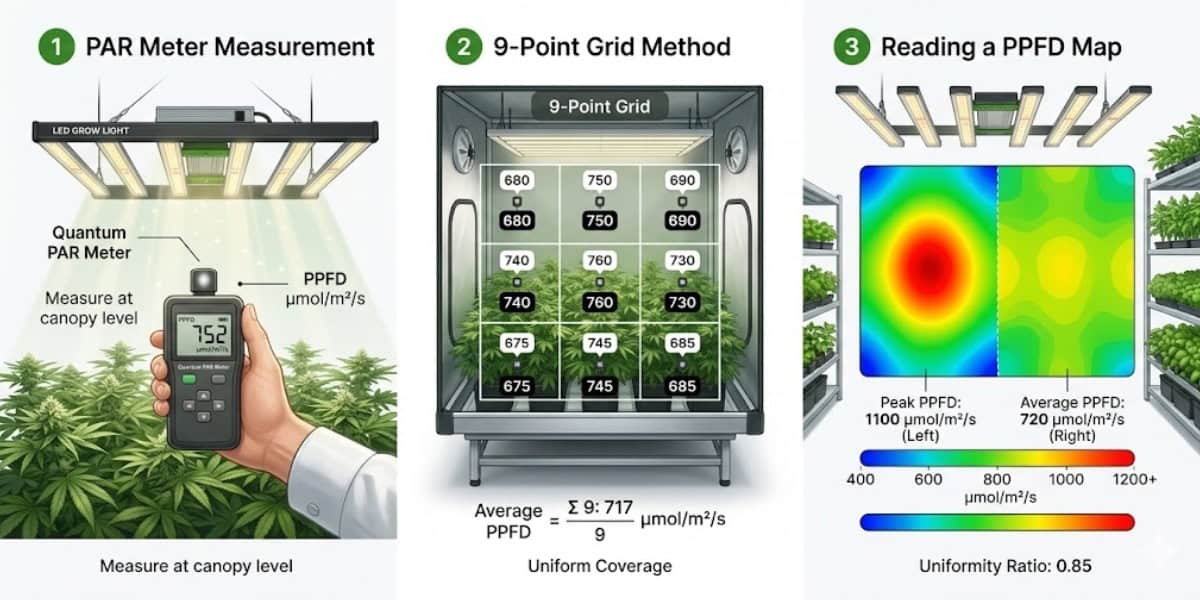
Uniformity matters almost as much as intensity. A room averaging 700 µmol/m²/s but swinging between 1200 and 300 across the canopy produces inconsistent plant morphology, uneven transpiration, and unpredictable harvest timing. Commercial facilities usually target uniformity ratios above 0.7 and preferably above 0.75.
Pushing PPFD Without CO2 Above 800
Plants require CO2 to use high photon density effectively. Without supplementation, most crops begin saturating near 800 to 1000 µmol/m²/s. Adding more light beyond that point increases energy cost faster than yield.
Confusing Lux Meters with PAR Meters
Lux meters measure brightness according to human vision sensitivity. Plants do not respond to light the same way humans do. Green-heavy lighting may register high lux values while contributing relatively little photosynthetic benefit.
The table below summarizes the most common PPFD mistakes growers make.
| engano | What Happens | Fix |
| Max PPFD at seedling stage | Bleaching, stunted growth | Start at 30 to 40 percent intensity, ramp up over 2 weeks |
| Single center measurement | Overestimates average PPFD | Take 9-point grid measurements and calculate average |
| Ignoring uniformity | Yield variation across canopy | Choose fixtures with uniformity ratio above 0.75 |
| High PPFD without CO2 | Diminishing returns above 800-1000 | Either add CO2 or reduce PPFD and extend photoperiod |
| Using lux meter for PPFD | Inaccurate readings | Use a quantum PAR sensor for accurate µmol/m²/s readings |
How to Measure PPFD in Your Grow Space
Tools You Need
Commercial growers rely on quantum PAR sensors because they directly measure photosynthetic photon density. Professional meters from companies like Apogee are widely trusted in horticulture because they accurately measure µmol/m²/s across the PAR spectrum.
Phone-based PAR apps can provide rough estimates, but sensor calibration limitations make them unreliable for commercial crop optimization. They may help hobby growers identify major lighting problems, but they are not accurate enough for high-value crops.
Smaller indoor gardens and propagation setups often use lower-power fixtures where canopy coverage matters more than raw wattage. The 150W LED grow light guide explains how spectrum, hanging height, and coverage area affect real PPFD performance in compact grow spaces.
The 9-Point Grid Measurement Method
Commercial growers rarely trust a single reading. Instead, they divide the canopy into a nine-point grid and measure PPFD at equal spacing across the grow area. Readings are averaged to calculate realistic canopy-level intensity.
This matters because plants growing at the edges determine overall yield consistency. A fixture producing excellent center intensity but weak corner coverage creates uneven crop development. Commercial facilities prioritize average PPFD and uniformity ratios over maximum hotspot readings.
[Image Placeholder: 9-point PPFD measurement diagram for a 4×4 grow area]
How to Read a PPFD Map From a Grow Light Manufacturer
A real PPFD map shows average, maximum, and minimum photon density across the fixture footprint at specific hanging heights. The most useful number is average canopy PPFD across your actual grow area.
Some manufacturers advertise only the center hotspot value because it looks impressive. Commercial growers pay closer attention to uniformity ratios and edge performance.
Kingrowlight publishes PPFD maps across multiple hanging heights and coverage areas for its fixtures because growers need realistic canopy-level data before purchasing lighting systems. Similar commercial practices are also seen in published PPFD map testing from companies like Mars Hydro, where full-grid canopy measurements reveal the difference between peak intensity and true average coverage.
<p>Professional growers comparing commercial fixtures usually evaluate real canopy coverage, thermal efficiency, and average PPFD instead of relying on marketing wattage alone. Buying comparisons like this Growers Choice LED grow light performance guide focus more heavily on practical cultivation performance metrics.
Matching Your Crop’s PPFD Target to the Right Kingrowlight Fixture
Knowing your target PPFD only solves half the problem. The fixture still needs to deliver that intensity evenly across your actual canopy size without excessive hotspots or weak edges.
For Leafy Greens and Herbs Medium PPFD Crops
Leafy greens, herbs, and microgreens perform best under stable medium-range PPFD with strong uniformity. The Kingrowlight S-series and D-series Grow Light Bars are designed for vertical farming systems and multilayer production because they distribute moderate photon density evenly across shallow canopies.
This matters more than raw intensity. Lettuce exposed to unstable PPFD often develops uneven head formation and inconsistent growth rates across racks.
For Tomatoes, Peppers, and High-Light Vegetables
Fruiting vegetables require substantially higher photon density, especially during flowering and fruit set. The Kingrowlight Foldable LED Grow Light and Foldable LED Grow Light Plus are designed for these environments because they combine strong output with wider canopy spread.
Tomato growers benefit from foldable bar layouts because they reduce center hotspots while maintaining high average PPFD throughout dense canopies.
For Cannabis and Maximum-PPFD Crops
Cannabis cultivation pushes fixtures harder than almost any other indoor crop. High-output environments require both intensity and deep canopy penetration.
The Kingrowlight Spider LED Grow Light and Linear LED Grow Light are designed for these applications because they provide high-output PPFD with wide distribution patterns suited for flowering rooms targeting 800 to 1500 µmol/m²/s.
Before purchasing any grow light, request the PPFD map for your specific canopy size. Average PPFD at your target height is the number that matters, not peak PPFD at one center point.
conclusão
PPFD is the number that connects your grow light directly to plant performance. Watts describe fixture power consumption. Lumens describe human brightness perception. PPFD describes the photons your plants actually receive for photosynthesis.
Growth stage matters just as much as crop type. A tomato seedling and a fruiting tomato plant require completely different photon density levels. The same is true for cannabis, lettuce, herbs, peppers, and nearly every commercial crop grown indoors.
DLI completes the picture because plants respond to total daily photon accumulation, not just instantaneous intensity. Both PPFD and photoperiod are variables growers can control.
The numbers in this guide are not targets for perfect conditions. They are starting points grounded in commercial horticulture data. Adjust based on your environment, your CO2 levels, and what your plants are showing you.
Explore Kingrowlight’s full LED grow light range designed around real PPFD targets for commercial and serious indoor growers.
