
 Portuguese
  English
  Spanish
  French
  German
  Dutch
Dutch  Italian
  Thai
Thai Indoor cannabis cultivation relies heavily on artificial lighting because plants no longer receive natural sunlight. In outdoor environments, the sun provides a broad spectrum of light with high intensity throughout the day. Indoor growers must replicate these conditions using grow lights that deliver sufficient photon intensity, balanced spectrum, and stable environmental control.
Lighting quality directly influences plant morphology, vegetative growth rate, flowering density, and cannabinoid production. Insufficient light intensity results in elongated stems and weak flowering, while excessive heat from inefficient lighting systems can stress plants and reduce yield.
For small home setups such as grow tents, closets, or compact indoor rooms, selecting the correct lighting system requires balancing plant requirements with practical limitations including energy consumption, heat management, and available space.
In This Guide We Will Explain
• Why lighting is critical for cannabis growth
• How different grow light technologies compare
• How much lighting power small grow spaces require
• What PPFD levels cannabis plants need at different stages
• How spectrum, heat management, and fixture placement affect plant performance
Quick Answer
When choosing cannabis grow lighting for a small home setup, the most important factors are light intensity, spectrum coverage, efficiency, and heat management. Modern full-spectrum LED grow lights are typically the best option because they provide high photon efficiency of 2.5–3.2 µmol/J, relatively low heat output, and balanced spectral coverage. Small growth areas generally require 30–40 watts per square foot and PPFD levels between 400–900 µmol/m²/s depending on the growth stage.
Why Lighting Is Critical for Indoor Cannabis Growth
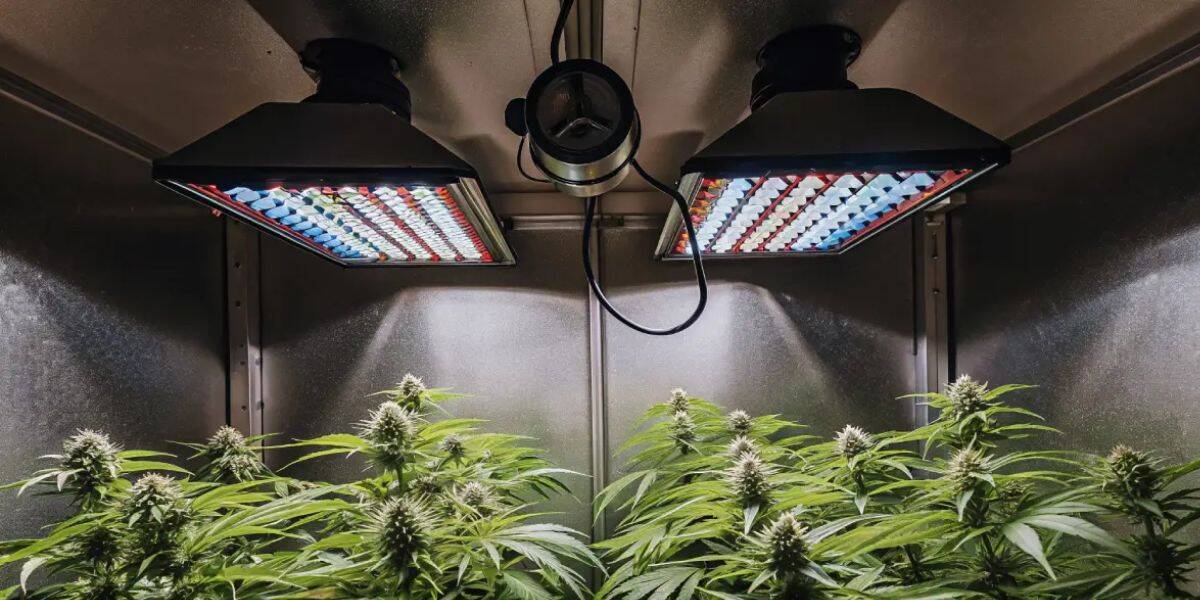
Cannabis plants rely on light energy to drive photosynthesis, the biological process through which carbon dioxide and water are converted into carbohydrates. These carbohydrates support leaf formation, stem development, and flower production.
In natural outdoor conditions, sunlight provides the full spectrum of photosynthetically active radiation (PAR), ranging from 400 to 700 nanometers. Indoor cultivation systems must replicate this environment using artificial grow lights.
Three lighting characteristics determine plant performance.
Light Intensity
Light intensity determines how many photons reach the plant canopy. When intensity is too low, plants stretch toward the light source and develop weak structures. Excessively high intensity can cause light stress or bleaching.
Light Spectrum
Different wavelengths influence plant morphology and metabolism. Blue wavelengths promote vegetative growth, while red wavelengths stimulate flowering and biomass production.
Photoperiod Control
Cannabis plants are photoperiod sensitive. Growers manipulate the light cycle to control plant development.
Typical schedules include:
Vegetative stage: 18 hours light / 6 hours dark
Flowering stage: 12 hours light / 12 hours dark
Decision Insight:
Indoor cultivation requires lighting systems capable of delivering sufficient intensity and balanced spectrum while remaining energy efficient. Full-spectrum LED systems generally provide the most controlled solution.
Types of Grow Lights
Indoor cannabis cultivation typically uses three lighting technologies: LED, HID, and fluorescent lighting.
Grow Light Technology Comparison
| Lighting Type | Efficiency (µmol/J) | Typical Heat Load per 100 W | Lifespan | Typical Application |
| LED Grow Lights | 2.5–3.2 µmol/J | ~60–70 W heat | ~50,000 hours | Small indoor grows, tents |
| HID (HPS/MH) | 1.4–1.9 µmol/J | ~80–90 W heat | 10,000–20,000 hours | Large grow rooms |
| Fluorescent (T5) | 0.8–1.2 µmol/J | ~70–80 W heat | 10,000–15,000 hours | Seedlings and cloning |
LED Grow Lights
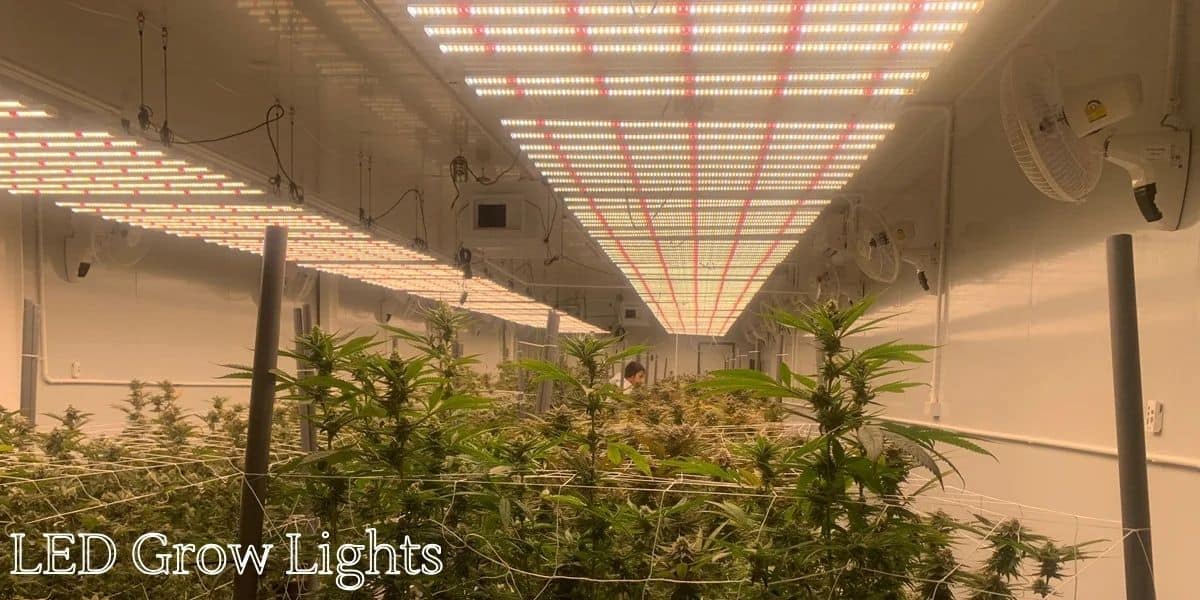
LED grow lights have become the dominant technology for indoor cultivation because they combine high efficiency with flexible spectral design.
Typical LED grow light specifications:
| Parameter | Typical Value |
| Photon Efficiency | 2.5–3.2 µmol/J |
| Typical Power Range | 100–600 W fixtures |
| Lifespan | ~50,000 operating hours |
| Heat Load | ~60–70 W heat per 100 W input |
| Spectrum Range | Full spectrum (400–700 nm) |
| Spectrum Control | Adjustable in some fixtures |
LED fixtures can combine multiple diode types to produce a balanced spectrum suitable for both vegetative and flowering stages.
HID Grow Lights
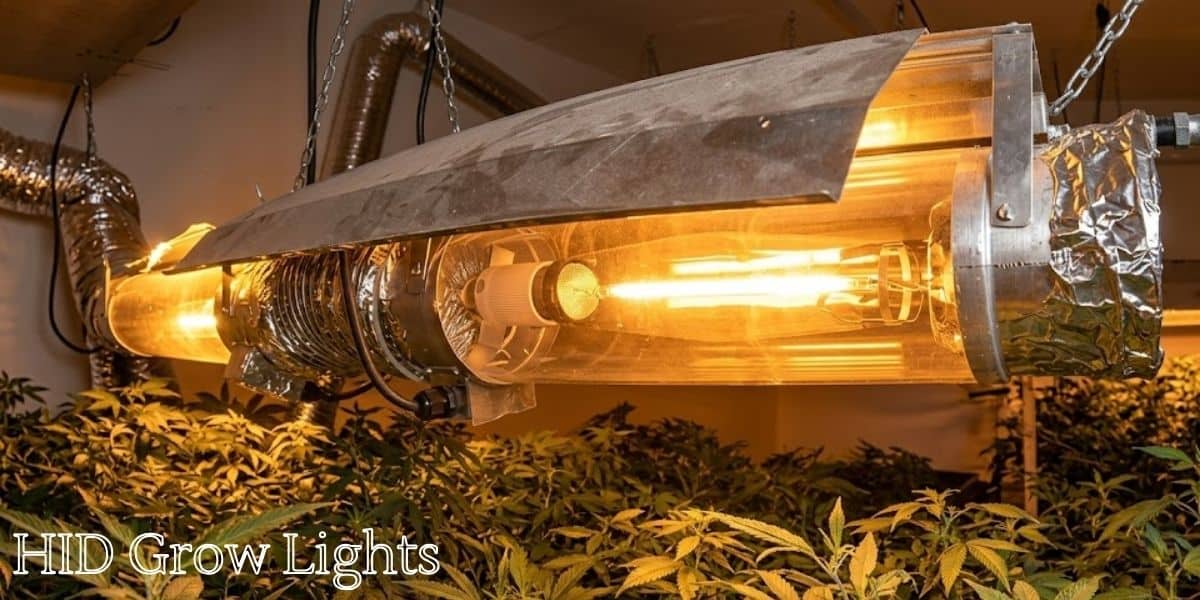
High-Intensity Discharge lighting includes Metal Halide (MH) and High Pressure Sodium (HPS) lamps. These were historically the standard lighting systems used in commercial cannabis cultivation.
| Parameter | Typical Value |
| Photon Efficiency | 1.4–1.9 µmol/J |
| Typical Power Range | 400–1000 W fixtures |
| Lifespan | 10,000–20,000 hours |
| Heat Load | ~80–90 W heat per 100 W input |
| Spectrum Range | 420–700 nm (MH/HPS dependent) |
| Spectrum Control | Fixed lamp spectrum |
HID systems produce strong light intensity but generate significant heat, making them difficult to manage in small grow spaces.
Fluorescent Grow Lights
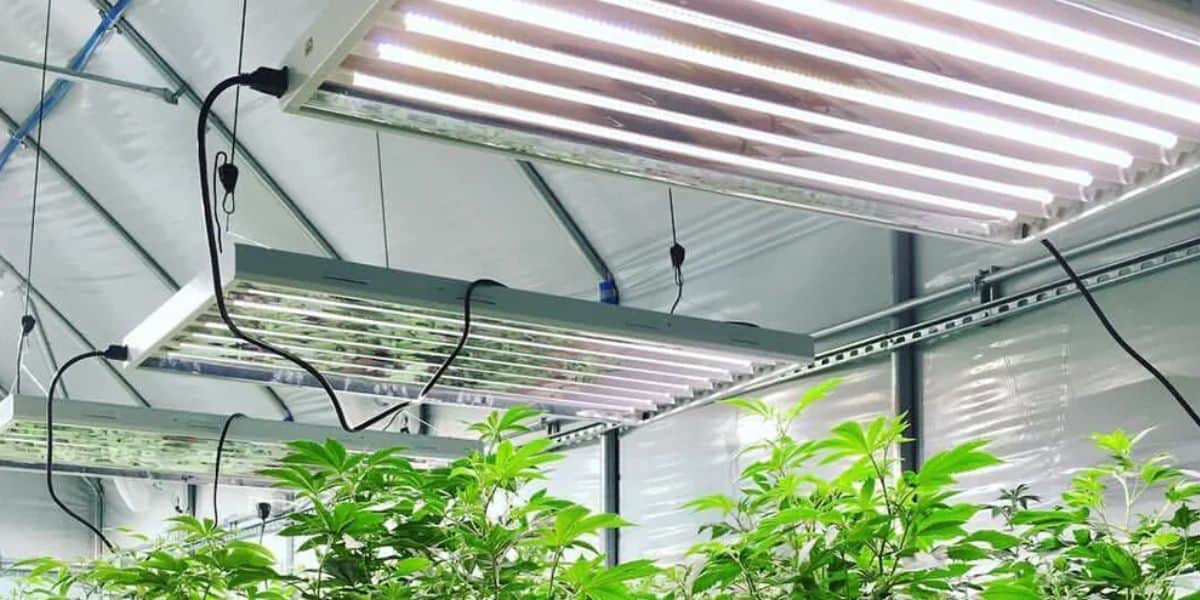
Fluorescent fixtures such as T5 grow lights are commonly used for early plant stages.
| Parameter | Typical Value |
| Photon Efficiency | 0.8–1.2 µmol/J |
| Typical Power Range | 24–54 W per tube |
| Lifespan | 10,000–15,000 hours |
| Heat Load | ~70–80 W heat per 100 W input |
| Spectrum Range | 400–650 nm |
| Best Application | Seedlings, clones, early vegetative stage |
Fluorescent lights generally lack sufficient intensity for flowering cannabis plants.
Decision Insight:
For most small home grow setups, full-spectrum LED grow lights provide the best balance between efficiency, intensity, and heat management.
Choosing Correct Wattage for Small Grow Spaces
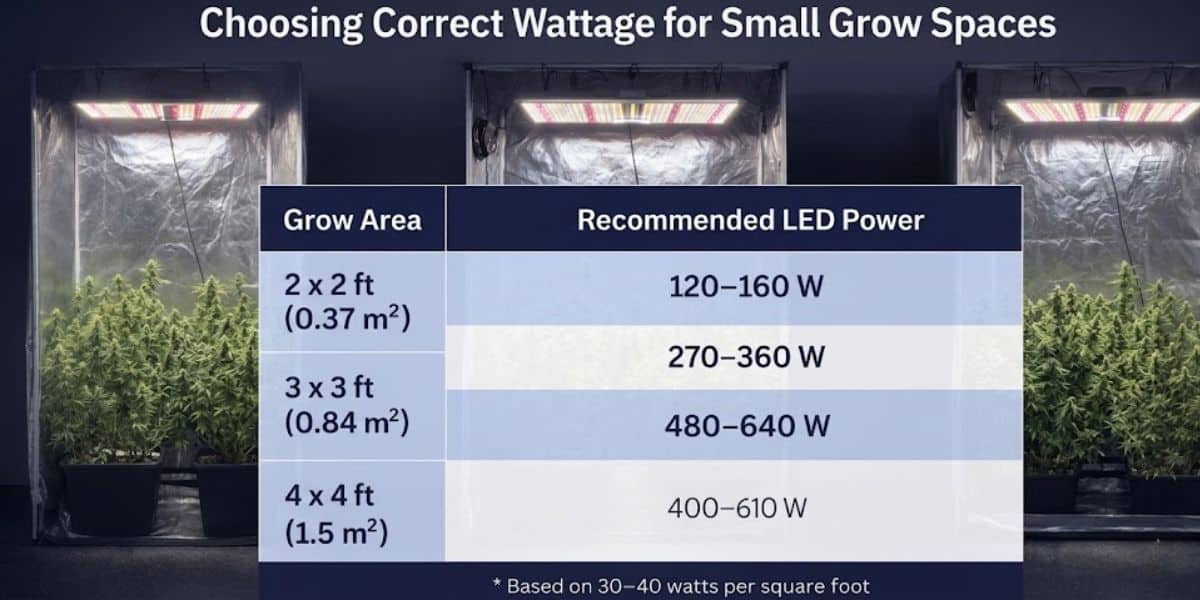
The required lighting power depends on the canopy area being illuminated. A widely accepted guideline for modern LED grow lights is 30–40 watts per square foot.
Recommended Wattage by Grow Area
| Grow Area | Recommended LED Power |
| 2 × 2 ft (0.37 m²) | 120–160 W |
| 3 × 3 ft (0.84 m²) | 270–360 W |
| 4 × 4 ft (1.5 m²) | 480–640 W |
For example, a 2×2 ft grow tent typically performs well with a 150 W LED grow light capable of producing adequate PPFD for flowering.
Exceeding recommended wattage may increase heat generation without significantly improving yield.
Decision Insight:
Selecting grow lights based on canopy area ensures balanced light coverage and efficient energy use.
Understanding PPFD and Light Intensity
PPFD (Photosynthetic Photon Flux Density) measures the number of usable photons reaching a square meter per second. It is expressed as µmol/m²/s and is the most accurate metric for evaluating grow light performance.
Typical PPFD Requirements for Cannabis
| Growth Stage | Recommended PPFD |
| Seedling | 200–300 µmol/m²/s |
| Vegetative | 400–600 µmol/m²/s |
| Flowering | 600–900 µmol/m²/s |
Uniform PPFD distribution across the plant canopy is essential for consistent plant development.
Many modern LED grow lights include PPFD maps that show light distribution across the coverage area.
Decision Insight:
For flowering cannabis plants, lighting systems should deliver 600–900 µmol/m²/s across the entire canopy.
Best Spectrum for Cannabis Plants
Light spectrum refers to the distribution of wavelengths emitted by the grow light. Cannabis plants respond to wavelengths within the photosynthetically active radiation (PAR) range of 400–700 nm.
Key Spectral Regions
| Wavelength Range | Effect on Plant Growth |
| 400–500 nm (Blue) | Promotes vegetative growth |
| 500–600 nm (Green) | Penetrates canopy layers |
| 600–700 nm (Red) | Stimulates flowering |
Full-spectrum LED fixtures combine multiple wavelengths to simulate natural sunlight.
Example Full Spectrum LED Configuration
| LED Type | Wavelength |
| Cool white | ~5000K |
| Warm white | ~3000K |
| Deep red | 660 nm |
Some advanced systems also incorporate far-red wavelengths (700–750 nm) to influence flowering response.
Decision Insight:
Balanced full-spectrum lighting covering 400–700 nm supports both vegetative growth and flowering cycles.
Heat Management in Small Grow Rooms
Heat management is critical in compact indoor grow environments. Excessive temperatures can cause plant stress, increased transpiration, and reduced photosynthetic efficiency.
Heat Output by Lighting Technology
| Lighting Type | Efficiency (µmol/J) | Heat Output per 100 W | Typical Fixture Temperature |
| HID (HPS/MH) | 1.4–1.9 | 80–90 W | 70–95°C |
| LED | 2.5–3.2 | 60–70 W | 40–65°C |
| Fluorescent | 0.8–1.2 | 70–80 W | 50–70°C |
Small grow tents typically rely on inline ventilation fans to maintain canopy temperatures between 22–28°C (72–82°F).
Decision Insight:
LED lighting significantly reduces heat load compared to HID systems, simplifying temperature management in small grow spaces.
Grow Light Placement and Distance
Correct fixture placement ensures even light distribution and prevents light burn.
Typical LED Hanging Distances
| Growth Stage | Recommended Distance |
| Seedling | 24–30 inches |
| Vegetative | 18–24 inches |
| Flowering | 12–18 inches |
Adjustable hanging systems allow growers to gradually lower lights as plants grow.
Decision Insight:
Maintaining proper fixture distance ensures optimal PPFD while preventing canopy damage.
Common Mistakes When Choosing Grow Lights
Beginner growers often select lighting systems based on marketing claims rather than technical performance.
Common mistakes include:
• Choosing lights with exaggerated wattage ratings
• Ignoring PPFD distribution maps
• Using insufficient intensity for flowering
• Installing fixtures too close to the canopy
• Overlooking ventilation requirements
Decision Insight:
Evaluating lighting systems using measurable metrics such as PPFD, photon efficiency, and actual power consumption leads to better cultivation outcomes.
Example Lighting Setup for a Small Home Grow
A typical home grow environment often uses a compact 2 × 2 ft or 3 × 3 ft grow tent.
Example 2 × 2 ft Grow Tent Setup
| Component | Typical Specification |
| Grow light | 150 W full-spectrum LED |
| PPFD at canopy | 650–750 µmol/m²/s |
| Hanging distance | 16–18 inches |
| Ventilation | 4-inch inline fan |
| Light schedule | 18/6 vegetative, 12/12 flowering |
This configuration provides sufficient light intensity while maintaining manageable heat levels.
Decision Insight:
Moderate-power LED fixtures are usually ideal for small grow tents because they provide balanced PPFD without excessive heat generation.
Final Decision
For small home cannabis cultivation setups, lighting should prioritize efficiency, balanced spectrum, and manageable heat output. Modern full-spectrum LED grow lights generally provide the most practical solution.
A grow light capable of delivering 600–900 µmol/m²/s PPFD during flowering, operating at 30–40 watts per square foot, and maintaining efficiency around 2.5–3.2 µmol/J will typically provide reliable results for small indoor cannabis grows.
Choosing the correct lighting system improves consistency and yield in indoor cultivation. You may also find our guide on indoor farming lighting systems helpful when designing a complete grow setup.
Conclusion
Selecting the correct grow lighting system is one of the most important decisions in indoor cannabis cultivation. Lighting directly affects plant growth rate, flower production, and overall crop quality.
Small indoor grow environments require lighting systems that deliver adequate intensity while remaining energy efficient and thermally manageable. Full-spectrum LED grow lights have become the preferred technology because they provide high photon efficiency, balanced spectrum, and relatively low heat generation.
By understanding key parameters such as PPFD, wattage per square foot, and fixture placement, growers can design lighting systems that support healthy cannabis growth throughout all development stages.
